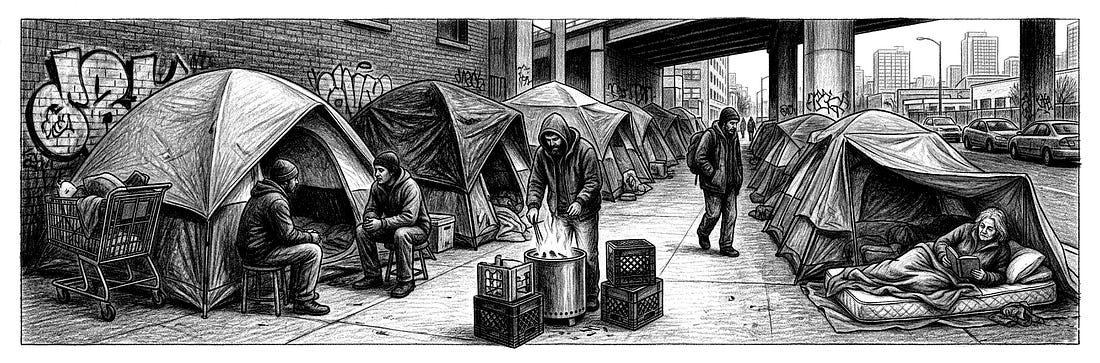
There is a particular kind of drive you take in Seattle on your way to the mountains. You pass through neighborhoods where tents cluster under overpasses, where men and women move slowly along sidewalks carrying everything they own, where the visible wreckage of human lives accumulates in the gutters of one of the wealthiest cities on earth. You signal, you merge, you move on. Most of us do. It has become part of the landscape.
That drive is a portrait of American healthcare policy. Not a metaphor. An actual consequence. The people in those tents are, in significant numbers, mentally ill, addicted, medically untreated, and financially destroyed. They are there because a system that could address their condition has chosen, at every structural level, not to.
This is not an accident. It reflects decades of policy choices that have consistently prioritised market returns over human welfare.
None of what follows is simple. The estimates are contested, the causes are intertwined, and the politics are brutal. But the broad outlines are clear enough, and have been for long enough, that complexity is no longer a satisfying excuse for inaction.
The Financial Injury The United States spends more on healthcare per capita than any other nation on earth, roughly double what Germany, France, or Canada spend, and ranks near the bottom of wealthy nations on outcomes like life expectancy, infant mortality, and chronic disease management.1 That gap between cost and result is not a policy failure. It is the predictable output of a system built around extraction rather than care.
Medical bankruptcy is essentially an American phenomenon. No other wealthy country allows a health crisis to simultaneously be a financial one. Estimates suggest medical bills contribute to more than 500,000 bankruptcies annually.2 That figure does not capture the millions more who do not file but are quietly crushed: depleting savings, skipping follow-up care, choosing between insulin and rent. A broken leg should not break a family. In America, it routinely does.
What makes this difficult to untangle is that the system is not really a system. It is a patchwork of misaligned incentives: hospitals, insurers, pharmacy benefit managers, and drug manufacturers each extracting their share in ways that are individually legal and collectively ruinous. The result is one of the most expensive, most administratively complex, and most inequitable healthcare systems among high-income peers, by nearly every comparative measure.
250,000 Deaths Nobody Counts In 2016, Dr. Martin Makary and Dr. Michael Daniel of Johns Hopkins University published a landmark analysis in the British Medical Journal. Their finding: approximately 251,000 Americans die each year from medical errors, a figure that would make it the third leading cause of death in the United States, behind only heart disease and cancer.3 The figure is disputed. Some researchers argue the methodology overstates deaths directly attributable to error; others contend it understates them. What is not disputed is that preventable harm in hospitals is a major and chronically under-measured cause of death in the United States. It does not appear on CDC mortality statistics. Death certificates have no checkbox for “preventable system failure.” The deaths are absorbed into other categories, invisible in the data, uncounted in the public reckoning. What is not counted is not fixed.
The errors span a wide spectrum: wrong medications, surgical mistakes, diagnostic failures, hospital-acquired infections, communication breakdowns between care teams, discharge errors that send patients home without proper follow-up. Most are not the result of a single bad actor. They are the result of structural pressure: understaffed units, fatigued residents, fragmented records, a culture that historically punished disclosure rather than rewarded it.
Medicine attracts people genuinely motivated to help. The oath to do no harm is real, and most physicians take it seriously. Yet the system places those people inside structures that make harm more likely. A nurse on her third consecutive twelve-hour shift. A physician managing thirty patients simultaneously. An electronic health record that cannot communicate with the hospital across the street. These are not individual moral failures. They are design failures. And 250,000 people a year pay for them with their lives.
The Price of Entry American physician compensation, often $250,000 to $500,000 annually for specialists, and sometimes exceeding $2 million, is frequently cited as evidence of greed. It is more accurately evidence of a broken cost structure that begins before a physician ever sees a patient.
Medical education in the United States requires four years of undergraduate study, four years of medical school, and three to seven years of residency at modest wages despite routinely working sixty to eighty hours a week. By the time a specialist is fully independent, they may be in their mid-thirties carrying $200,000 to $300,000 in student debt, with a decade of deferred earnings behind them.4 Malpractice insurance adds another layer. A general practitioner might pay $15,000 annually. An OB/GYN in a high-litigation state can pay $150,000 or more. A neurosurgeon may pay $300,000 per year, simply for the right to practice. This is driven in part by a litigation culture born from a painful reality: in a country without a universal safety net, a malpractice suit is sometimes the only recourse available to a patient who has been harmed.
In Europe, medical education is heavily subsidised or free. Malpractice is handled through administrative tribunals with capped awards. Physicians earn comfortable upper-middle-class salaries without requiring seven-figure compensation to justify the investment. The patient pays less. The doctor works within a more rational structure. The outcomes, by most measures, are better.
The American physician’s salary is not the cause of the problem. It is a rational response to an irrational system. Attacking physician pay without addressing education costs and malpractice reform would simply make medicine less attractive without curing anything.
The Solidarity Problem Every European country with functional universal healthcare operates on a principle called social solidarity: you pay into the system based on your means, you draw from it based on your need, and you are grateful if the balance runs in your favour, because it means you stayed healthy. The transaction is not a purchase. It is participation in a collective guarantee.
This is not a complicated idea. It is how fire departments work. How car insurance works. How Social Security works. Americans participate in solidarity systems constantly; they simply resist naming them that way.
The resistance has roots. A nation built on the mythology of individual self-reliance does not easily embrace the notion that your neighbour’s cancer is partly your problem. Two world wars fought on European soil created a visceral understanding that individual fate is bound to collective fate. America’s wars were fought elsewhere, and the lesson did not land the same way.
There is also a darker thread. Research consistently shows that support for social programs in the United States correlates with perceptions of who benefits.5 The deliberate racial coding of welfare, Medicaid, and public housing, and the framing of solidarity programs as transfers to “other people,” has fractured working-class coalitions for decades, persuading Americans to vote against their own economic interests. The result is a country that pays, in taxes and premiums, more per capita for healthcare than nations with universal systems, and receives less.
The Gutters Return to that drive through Seattle. The people in the tents are not there because Seattle is too generous. They are there because the rest of the country is not generous enough. Cities that try hardest to provide shelter, services, and harm reduction become magnets, not because they have solved the problem but because they are the only places attempting to manage it. The cruelty is that compassion gets blamed for the visible suffering it is trying to contain.
Homelessness in America is, at its core, a healthcare and housing crisis with deep medical roots. Federal data consistently show that a significant share of unsheltered adults live with serious mental illness or substance use disorders, conditions that are medical in nature but addressed primarily through criminalisation rather than treatment.6 The deinstitutionalisation of psychiatric facilities beginning in the 1980s, a policy that emptied beds without building community alternatives, planted a seed that has grown into a crisis spanning four decades. Medical financial ruin compounds it: a single diagnosis, accident, or surgery can eliminate the margin that separates housing stability from the street.
These are not separate problems. They are one problem: the absence of a social contract that treats human welfare as a collective responsibility.
Both Things, Simultaneously America is not without virtues. The space, the freedom, the staggering natural landscape, the cultural looseness that accommodates reinvention and eccentricity: these are real and they matter. People choose to live here for reasons that are not simply ignorance of alternatives. The trade has genuine value on both sides.
But both things can be true simultaneously. A country can offer extraordinary individual freedom and fail catastrophically at collective responsibility. It can produce the most sophisticated medical technology in the world and kill 250,000 people a year through preventable errors. It can spend more on healthcare than any nation on earth and leave families bankrupt from a diagnosis. It can build the largest companies in human history and let people die untreated two miles from their headquarters.
The solutions are not mysterious. They exist. They have been implemented, in various forms, across dozens of countries with different cultures, different governments, and different histories. The barrier is not knowledge or capability. It is political will, shaped by decades of lobbying by insurance companies, pharmaceutical manufacturers, and hospital systems whose revenues depend on the status quo, and by a cultural philosophy of individualism that has been exploited to make solidarity feel like surrender.7 The remedies are not radical. Other countries have built them, iteratively, out of ordinary political will: Universal coverage that eliminates medical bankruptcy, through a public option, Medicare expansion, or a hybrid model that preserves private supplementary insurance for those who want it.
Community mental health infrastructure: rebuild the inpatient and outpatient capacity dismantled in the 1980s, funded at the scale the need actually demands.
National patient safety standards: mandatory staffing ratios, standardised error reporting, and legal protection for clinicians who disclose mistakes, so that the 250,000 deaths we are not counting start being counted, and then reduced.
Until that changes, we will keep driving around the gutters. We will keep merging, and signalling, and moving on. And the people in the tents will keep dying of things that, in a different country, would have been treated.