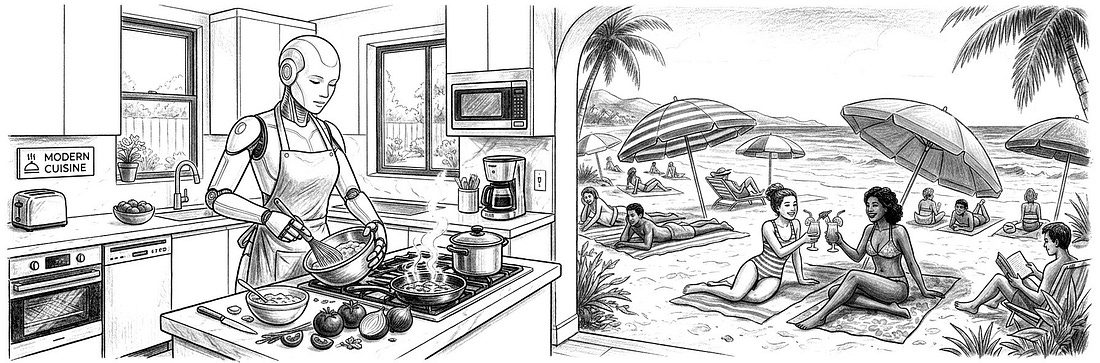
By 2030, activities accounting for up to 30 percent of hours worked in the U.S. economy could be automated, according to the McKinsey Global Institute.1 Most of us are still deciding what to have for lunch.
AI has quietly moved into our daily lives. It drafts our emails, answers our questions, translates our words, and generates our images. For those paying attention, it is nothing short of astonishing. For those who are not, it is a slow-moving wave they will eventually realize they have been standing in front of all along.
I use AI almost every day. I run drafts through one model and then feed the result to a second for critique. The collaboration between two artificial minds, mediated by one very human editor, often yields results I am genuinely proud of. That is either a remarkable achievement for technology or a humbling commentary on human effort. Probably both.
So let me offer an honest accounting: the blessings first, then the parts that keep me up at night, and finally what we might actually do about them.
The Blessings The productivity gains are real and they are immense. AI excels at the repetitive and the tedious. Feed it a screenshot of a table and ask it to extract a specific column of numbers and process them any way you like. It does it cleanly, quickly, and without complaint. Tasks that once consumed hours now take minutes.
For writers, AI is a remarkable collaborator. It can take rough, unpolished thinking and return something legible and structured, without erasing the original voice. The ideas remain yours. The readability improves dramatically.
Translation is another quiet revolution. Real-time, nuanced, cross- cultural communication is getting better every day, breaking down language barriers that have separated people for centuries.
AI also functions as a remarkably sophisticated search engine, one that understands plain language. Where once you needed to master SQL queries or learn specialized search syntax, you can now simply describe what you are looking for and with what constraints. This has democratized access to information in ways that are easy to underestimate.
And then there is the conversational dimension. In many everyday interactions, AI is sufficiently convincing that the distinction between human and machine response has become practically irrelevant. It listens, responds thoughtfully, and engages with apparent curiosity. For someone craving intellectual stimulation, it can feel like having a knowledgeable companion available at any hour. As we will see, that particular blessing carries its own shadow.
The Curses Jobs. Not long ago, a computer science degree was a reliable ticket to a well-paying career as a software engineer. That guarantee is eroding. A controlled experiment by Microsoft Research and MIT found that developers using GitHub Copilot completed tasks 55.8 percent faster than those without it.2 That is a blessing for output and a warning sign for headcount. The disruption is spreading well beyond software. Accountants, CPAs, attorneys, medical diagnosticians, architects, copywriters, screenwriters: entire professions built on years of training are facing meaningful displacement. AI is automating tasks faster than it is eliminating jobs outright, at least for now. But the trajectory over the next decade is genuinely uncertain, and the optimistic scenarios require deliberate policy intervention that we have not yet made.
Creative industries are under particular pressure, and the legal landscape is actively contested. Generative AI consumes existing art and music, reassembles it, and produces something nominally new. The artist’s original work gets decomposed into data, absorbed into a model, and reappears in a thousand outputs with no attribution and no compensation. Several major lawsuits are already working through the courts. Promising remedies are emerging: licensing frameworks, dataset watermarking, model-ownership proposals, and royalty schemes for creative inputs. The law will eventually catch up. The question is how much damage is done in the interim.
Content overload follows naturally from these capabilities. Anyone, and I include myself in this indictment, can now produce a novel, an op-ed, a painting, or a film score in a fraction of the time it once required. The result is an avalanche of content, much of it competent, little of it essential. The signal-to-noise ratio of human expression is deteriorating, and AI is the accelerant.
Social isolation is a risk worth taking seriously, particularly for those who already struggle with human connection. Research on AI companion apps and heavy chatbot use suggests that for some users, extended reliance on AI conversation can reduce motivation to invest in human relationships. AI is patient, consistent, and non-judgmental in ways that people often are not. Over time, real relationships can begin to seem too demanding by comparison. The loop tightens. The isolation deepens.
Energy consumption rarely makes the front page of the AI conversation, but it deserves to. Researchers found that training GPT-3 produced roughly 552 metric tons of carbon dioxide equivalent, comparable to the annual emissions of 123 gasoline-powered vehicles.3 Data center energy demand is projected to double by 2030, and much of that electricity is still generated by fossil fuels.
Misinformation is the risk with perhaps the highest stakes. In February 2024, a finance worker at the engineering firm Arup was tricked into wiring $25 million after fraudsters staged a deepfake video conference using AI-generated likenesses of senior executives.4 The FBI’s 2025 Internet Crime Report logged more than 22,000 AI-related fraud complaints, with losses exceeding $893 million.5 The technology already exists to clone a voice from a few seconds of audio. Detection tools, content authentication standards, and media literacy education are all part of the mitigation picture, but none of them are keeping pace with the generation capabilities.
There is also the smaller, daily irritant of hallucination. AI presents uncertain information with the confidence of certainty. It invents citations, misremembers facts, and occasionally generates a hand with six fingers. Until cross-referencing becomes standard practice, the responsibility for verification falls squarely on the human holding the output.
The Robot in the Room AI is only part of the story. Its physical sibling, robotics, is closing fast.
Car assembly plants are already largely automated. Amazon warehouses run on robot logistics. Surgical robots assist in operating rooms. And the household version is coming. Imagine Charles: a domestic robot who starts the coffee machine before you get out of bed, does the laundry, loads the dishwasher, reads you the morning headlines, and tells you to bring an umbrella. A more advanced Charles might serve as an au pair, teaching your young children a second language with infinite patience and perfect pronunciation. No sick days. No bad moods. Just quiet, competent service.
Charles sounds wonderful. He also represents the next frontier of labor displacement. If AI is restructuring white-collar work, robotics is coming for the rest. Blue-collar jobs in construction, logistics, food service, and agriculture will follow the arc that manufacturing already has. The timeline varies by sector, skill level, and geography. A welder in Detroit faces a different horizon than a delivery driver in rural Bangladesh. But the direction is consistent, and developing economies with large informal labor markets face some of the steepest adjustments, with the least policy infrastructure to absorb them.
What Society Needs to Do The honest answer is that we are not ready, and readiness requires deliberate choices we have so far avoided making.
The most discussed policy response is Universal Basic Income: a guaranteed floor of financial support for every citizen, funded in part by taxing the productivity gains that AI and robotics generate. Several pilots have tested this idea. Finland’s two-year UBI experiment showed improved wellbeing and mental health among recipients, with no reduction in employment motivation.6 Stockton, California’s guaranteed income program produced similar findings.7 Scaling these results to national policy remains politically difficult, but the evidence base is growing.
A complementary lever is an automation or productivity tax: a levy on companies that replace human workers with AI or robotic systems, with proceeds directed toward retraining funds and social insurance. The idea has been discussed in the EU and floated in U.S. policy circles. It has not yet found the political moment. It will.
Education and retraining must also be redesigned from the ground up. What skills remain distinctly human? Empathy. Ethical judgment. Creative vision. Physical craft. Relational intelligence. These deserve investment as core competencies, not soft supplements. Germany’s dual vocational training system offers one model for pairing technical education with real-world application. Sectoral retraining programs, targeted at workers in specific industries facing displacement, offer another.
On intellectual property, the immediate steps are clearer: mandatory disclosure of training data sources, licensing frameworks that compensate creators, and watermarking standards that allow AI- generated content to be identified and attributed. The EU AI Act, which began phasing in this year, moves in this direction. The U.S. is moving more slowly.
The Deeper Question Suppose we get the policy right. Suppose UBI exists, the tax base is sound, retraining works. There remains a question that economics cannot fully answer: what do we do with our time?
For most of human history, work has been the organizing structure of daily life. It provides income, yes, but also identity, purpose, social connection, and rhythm. A world in which machines handle the tedious, the dangerous, and the repetitive sounds liberating in theory. In practice, liberation without direction can feel like emptiness.
This is not a new problem. Aristotle worried about what citizens would do with leisure if slaves did the labor. We are approaching a technological version of that question, without slaves, but with the same structural challenge.
The psychological research on long-term unemployment is sobering: joblessness, even financially comfortable joblessness, tends to corrode wellbeing over time. Meaning matters as much as money.
Some people will paint. Some will volunteer. Some will raise children, tend gardens, build communities, make music, or travel. Some will write op-eds.
Others will struggle. The transition will not be uniform, and the communities least equipped to adapt will bear the most acute costs. That is where policy attention is most urgently needed.
Where This Leaves Us AI is net positive. That is my honest assessment after daily use. The productivity, the accessibility, the creative assistance: these are genuine and substantial gains. And Charles, when he arrives, will be a genuine blessing for the tired and the busy.
But we are moving faster than we are thinking. The job disruption is real and accelerating across both white-collar and blue-collar work. The creative economy is being restructured without adequate compensation for the people whose work trained the models. The social and psychological effects are only beginning to emerge. The energy cost is real and undercounted. The tools for deception are becoming more convincing every month.
The policy responses exist and they are not exotic: automation taxes, UBI pilots scaled to national programs, mandatory training-data licensing, content authentication standards, and educational investment in distinctly human skills. None of it requires waiting for the perfect moment. The moment is now.
One thing any reader can do today: contact your elected representatives and ask where they stand on AI regulation and automation taxes. The legislation being written in the next two to three years will shape the distribution of AI’s gains and costs for a generation.
The blessing and the curse are not separate things. They are the same thing, seen from different angles. The very qualities that make AI and robotics powerful are precisely what make them disruptive.
That is not an argument for stopping. It is an argument for governing: wisely, urgently, and before the wave decides for us.
The author uses AI daily, holds it in equal parts admiration and suspicion, and is already thinking about what to name his robot.