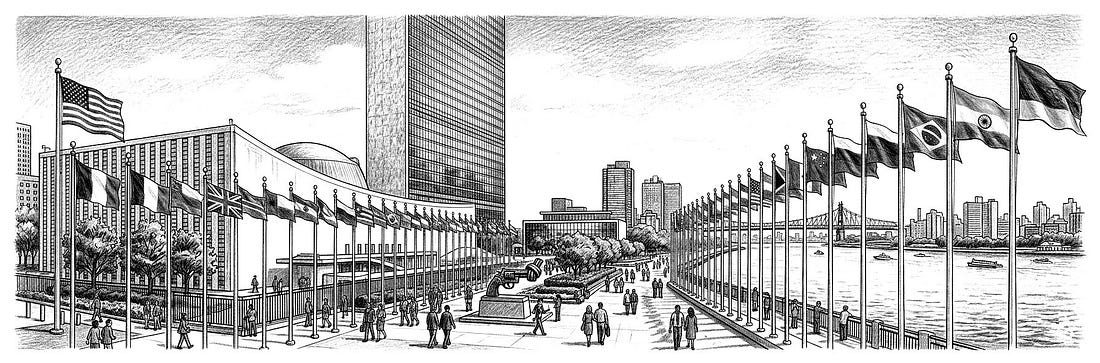
The standard objection to world government arrives quickly and with confidence: it is utopian, unworkable, a fantasy dressed in the language of political philosophy. Serious people, the argument goes, deal with the world as it is: a system of sovereign nation-states, each pursuing its own interests, kept in rough equilibrium by deterrence, diplomacy, and the occasional war.
What serious people rarely do is look at the outcomes of that system and ask whether they are acceptable.
They are not.
The world currently spends approximately $2.7 trillion annually on military forces, a record high, rising steeply, and consuming resources that could eliminate extreme poverty, close the global healthcare funding gap, and fund the clean energy transition in the countries that need it most.1 The arithmetic is not complicated. The politics are. Specifically: the structural logic of a world organised around mutual fear makes the missile always more urgent than the school, the weapons programme always more fundable than the hospital. This is not a failure of individual governments. It is the predictable output of a system in which every nation must arm itself against every other nation, because there is no alternative.
That is the problem a world government solves.
What the Objections Actually Prove The standard objections to world government are worth taking seriously, because most of them, examined carefully, turn out to be arguments for getting the design right rather than arguments against the project itself.
Human nature. People are tribal, nations are selfish, power corrupts. True on all counts. But this objection proves too much. By the same logic, every federal union in history was impossible. The United States, Switzerland, Germany, India: all are federations of previously competing, mutually suspicious political units that found, at some point, that the costs of the existing arrangement outweighed the risks of a new one. They did not federate because human nature changed. They federated because their founders designed institutions that worked with human nature, channelling self-interest, tribalism, and the appetite for power into a system of productive competition and mutual constraint. The question is not whether human nature permits world government. It is whether world government can be designed to accommodate human nature. It can be.
Tyranny risk. A world government, the objection goes, would be the most dangerous institution in history: a single power with no external check, nowhere to flee. This is the most serious objection, and it deserves a serious answer. The answer is that tyranny enters through specific mechanisms: an unchecked executive, enforcement bodies answerable only to themselves, courts that can be captured, and a world constitution can be written to block each of those mechanisms by design. No single executive. Two independent enforcement bodies of precisely equal strength, each a check on the other. Judges selected by lottery from pools nominated by national supreme courts, eliminating political horse-trading at the source. The design problem is real. It is also solvable.
The powerful will never agree. This is historically true in the short run and historically false in the long run. The path to world government does not require the simultaneous consent of every great power. It begins with the nations that have the most to gain: the smaller democracies that currently have no meaningful military power and no real seat at the table where decisions affecting them are made. A coalition demonstrating the concrete benefits of membership creates a gravitational field. Trade incentives for membership, designed carefully, make the cost of staying outside unbearable over time. This is how every successful federation expanded.
What a World Constitution Actually Does The case for world government is weakened, not strengthened, by vagueness. So it is worth being specific.
A world constitution does not replace nations. France remains France. India remains India. Every nation retains its language, culture, legal traditions, and the right to govern its internal affairs as its people choose. The world’s diversity of human expression is not threatened by a world constitution. It is protected by one, because the alternative is a world in which the powerful few impose their preferences on the powerless many by force, already eliminating that diversity at scale.
A world constitution does not govern everything. It governs a strictly limited set of matters that nations cannot handle alone: the prevention of war between nations, the protection of a small number of universal human rights, and the stewardship of the shared environment. Everything else remains the sovereign domain of each nation and its people. The principle here is subsidiarity: decisions made at the lowest level of governance capable of effectively addressing the matter.
A world constitution does enforce its own rules. This is the point where every previous international institution has failed. The United Nations Security Council can be vetoed by any permanent member. The International Court of Justice issues rulings that nations can ignore. A world constitution worthy of the name has courts whose orders are binding and enforcement bodies that can give those orders teeth. No nation above the law, including the powerful ones.
A world constitution does redirect resources. Through a constitutionally mandated levy on former military expenditure, at the same percentage rate for every nation, proportional to what each was spending on weapons, and it creates a Human Welfare Fund disbursed for healthcare, education, poverty reduction, and clean energy in the countries that need it most.2 At a fifteen percent levy rate, this fund reaches approximately $400 billion annually. Not charity. Not foreign aid dispensed at the pleasure of the donor. A constitutional obligation, enforceable like any other.
The Peace Dividend Is Real Consider what happens when a world constitution is ratified and national militaries begin the managed disarmament process. The United States, currently spending nearly $1 trillion annually on defence, contributes a fixed percentage to the common fund and retains the remainder. At a fifteen percent levy, the United States contributes approximately $150 billion to the Human Welfare Fund and retains $850 billion it was previously spending on weapons, free to invest in its own infrastructure, its own schools, its own people. Every nation’s peace dividend stays largely at home.
This is not redistribution. It is a refund on the most expensive protection racket in human history, namely the arms race, which is at its core a coerced expenditure. Every nation that would prefer to spend its defence budget on hospitals and schools cannot do so under the current system, because its neighbours are armed and the system provides no alternative. The world constitution ends the coercion by ending the race simultaneously for everyone.
The Marshall Plan rebuilt Western Europe after the Second World War. It was not called socialism. It was called investment in stable trading partners, in functioning markets, in a world order that served the long- term interests of those who funded it. Healthy, educated populations in the developing world are not charity cases. They are future trading partners, future contributors to global innovation, future members of a stable international order that benefits everyone who participates in it.
The Argument Einstein Made The intellectual case for world government has been made with precision and rigour by some of the twentieth century’s most serious minds. Grenville Clark and Louis Sohn spent a decade producing World Peace Through World Law (1958), a meticulous draft of a world legal order that remains the most detailed constitutional blueprint for international governance ever written.3 Albert Einstein spent the last decade of his life making the same argument: in speeches, essays, Atlantic Monthly editorials, open letters to the United Nations, and finally in the Russell-Einstein Manifesto, signed one week before his death in 1955.4 He was not naive about the obstacles. He was precise about the mechanism.
“There is no compromise possible between preparation for war, on the one hand, and preparation of a world society based on law and order on the other.”
-- Albert Einstein, 1947 He was right in 1950. He is right now. The difference between 1950 and now is that the tools for building the alternative have improved, the costs of the existing system have become impossible to ignore, and the generation now entering political life is the first to have grown up understanding that the threats most likely to end civilisation, namely nuclear miscalculation, pandemic, and climate, are precisely the ones that no nation-state can address alone.
The Question Is Not Whether. It Is When. A world constitution will not be drafted in Washington or Beijing. It will not emerge from a summit of great powers convening in good faith to surrender their weapons. It will be built, as every constitutional order has been built, from the bottom up, by people who have decided that the current arrangement is unacceptable, who say so persistently, and who create the political conditions in which the alternative becomes possible.
The institutions of world government do not need to wait for universal agreement. They need a coalition large enough to demonstrate their benefits and credible enough to expand. Every successful federation in history began as a partial arrangement among a subset of willing parties. The doors stayed open. The holdouts came in, not because they became virtuous, but because they did the calculation and found that membership was better than isolation.
The case for a world constitution is not a case for perfection. It is a case for a system that is structurally less dangerous than the one we have, one that replaces the armed standoff among sovereign states with a constitutional order in which the incentives point toward cooperation rather than conflict.
The existing system has been given a very long time to demonstrate that it can manage the threats it creates. It has produced thirteen thousand nuclear warheads, a climate crisis that no nation can solve alone, and a pandemic response that killed millions of people who did not need to die because the nations of the world could not coordinate a response that was obviously in all of their interests.
The question serious people should be asking is not whether world government is realistic. It is whether the current arrangement is.
It is not.
The work begins with that recognition.