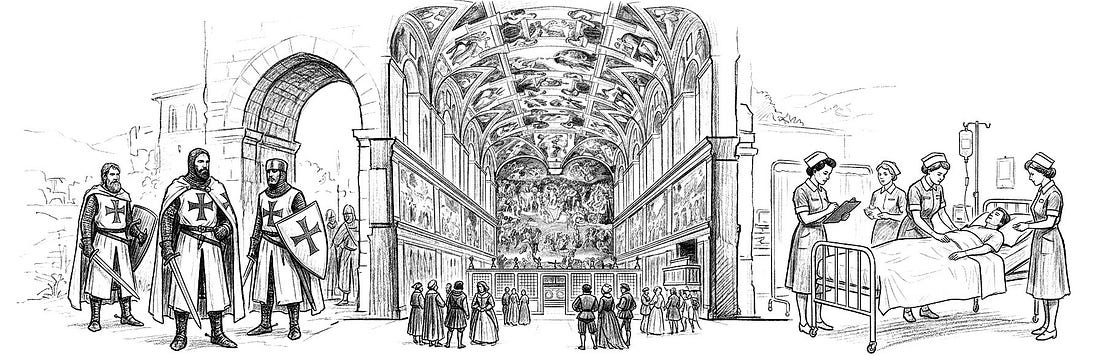
The First Amendment contains a deliberate paradox: it promises both freedom of religion and freedom from religion. Congress, it says, shall make no law respecting an establishment of religion, or prohibiting the free exercise thereof. Two protections in one sentence, pointed in opposite directions and inseparable from each other. The freedom to believe whatever you choose, and the freedom from having someone else’s belief imposed upon you. The founders, many of them personally religious and nearly all of them historically literate about what happens when church and state fuse, understood that genuine religious liberty requires both guarantees simultaneously. You cannot have one without the other.1 America took that framework seriously, and the result is a nation of extraordinary religious diversity. Christianity in dozens of denominations, Islam in Sunni, Shia, and Sufi traditions, Judaism in Orthodox, Conservative, and Reform branches, Hinduism, Buddhism, Sikhism, Jainism, indigenous spiritual practices, secular humanism, and a growing population that identifies with no religious tradition at all.2 They coexist, mostly peaceably, under the same constitutional umbrella. Under American law, all of this is permitted, protected, and none of anyone else’s business, provided it does not cross into conduct that violates secular law.
That is the ideal. The history of how it has been lived is more complicated, more interesting, and considerably more troubling.
Common Roots, Divergent Paths The following observations focus primarily on the Abrahamic faiths, not because they exhaust the world’s religious traditions but because their history is most directly relevant to the American constitutional and political context this essay addresses.
Christianity, Judaism, and Islam all trace their origins to a single patriarch. Abraham, the founding figure of all three, appears in the Hebrew Bible, the Christian Old Testament, and the Quran. From that common root, three distinct traditions emerged over millennia, each developing its own scripture, its own law, its own understanding of the divine, and its own account of what humanity owes to God and to each other.3 What is striking, looking across all three, is not how different they became but how similar the pattern of their internal conflicts has been. Each produced mainstream traditions and radical derivatives. Each has known moments of extraordinary moral clarity and episodes of extraordinary violence committed in God’s name. Each has generated reformers who challenged the institution from within and extremists who claimed divine sanction for actions the mainstream tradition would disown. The Crusades, the Inquisition, the pogroms, the jihads declared against civilian populations, the sectarian violence that has consumed parts of the Middle East, Northern Ireland, and the Indian subcontinent: these are not aberrations in the history of religion. They are a recurring pattern, one that repeats whenever the authority of faith is fused with the coercive power of the state or the organized violence of armies. Importantly, these are failures of institutions and of political actors who weaponize belief, not indictments of the millions of ordinary believers who practice their faith with sincerity and decency.
The Good, Genuinely Religion, for the vast majority of the people who practice it, is not primarily about power or politics or institutional finance. It is about meaning.
The person sitting in a pew, kneeling on a prayer mat, or lighting Shabbat candles is not, in most cases, making a political statement. They are reaching for something larger than themselves, finding community with others who share their understanding of the world, and drawing on a tradition of accumulated moral wisdom to navigate the difficulties of being alive. The grief of bereavement, the anxiety of illness, the weight of guilt, the search for purpose in a life that does not always offer obvious answers: religion often serves these needs in ways that secular institutions struggle to replicate, and it continues to do so for billions of people who find in faith what they cannot find elsewhere.
The social works are real too. Food banks staffed by church volunteers. Hospital wings built by religious orders. Schools founded in communities that had none. Hospices run on the conviction that the dying deserve dignity and presence. Addiction recovery programs grounded in the language of community accountability. The women and men who perform this work frequently do so at significant personal cost, motivated by a genuine conviction that service to others is service to God.4 That motivation deserves respect, regardless of whether one shares the theology behind it.
The Institution and the Faithful The difficulty arises when the institution, which is a legal and financial entity as well as a spiritual one, diverges from the people who embody its stated values.
The Catholic Church in Germany offers a particularly clear example. It is one of the largest employers in the country, with roughly two million workers, a figure that encompasses not only clergy but healthcare staff, social workers, and educators across church-affiliated institutions.5 Many of these are sisters, nurses, and caregivers for the elderly and the sick, hospice workers and social service providers who have devoted their professional lives to the care of those most in need. The work they do is genuine. But the financial arrangement deserves scrutiny.
These workers frequently earn minimum wage or near it, and in many cases live in church-owned housing, which ties their residential security to their continued employment. The institutions for which they work charge market rates for the services those workers provide. The differential between what the worker earns and what the institution charges for their labor is retained by the organization, not the individual.
The broader financial structure compounds the concern. Germany’s church tax system, dating to the nineteenth century, automatically deducts a surcharge of eight to nine percent of members’ income tax liability and remits it to the established churches, generating approximately €12–13 billion annually for the Catholic and Lutheran churches.6 The arrangement would be constitutionally impermissible in the United States. It illustrates how deeply institutional religion can embed itself in the machinery of civil governance when the wall between them is not vigilantly maintained.
The Business of Faith The Church’s relationship with money is not a modern phenomenon. It is as old as the institution itself.
In the sixteenth century, Pope Leo X faced a familiar institutional problem: the Vatican needed funds for the rebuilding of St. Peter’s Basilica. The solution was the aggressive sale of indulgences: certificates, formally issued by papal authority, promising the reduction or elimination of time in purgatory for sins already committed, either by the purchaser or by deceased relatives on whose behalf the purchase was made.7 The commercial machinery was blunt. Preachers toured Europe with the message that monetary contribution could purchase divine forgiveness. Johann Tetzel, the Dominican friar most associated with the campaign in Germany, reportedly used the slogan: as soon as the coin in the coffer rings, the soul from purgatory springs. The faithful were being sold something that, by any honest assessment, only God could provide.
A monk and theologian in Wittenberg found this intolerable. Martin Luther’s 95 Theses, posted in 1517, were not initially a call to break from Rome. They were a call for accountability: for honest reckoning with the gap between what the institution claimed and what it was doing. What they became was the spark for the Protestant Reformation, a rupture in Western Christianity that produced denominations numbering in the thousands.8 Luther’s argument, that the authority of scripture is not the same as the authority of the institution that claims to interpret it, remains the template for every subsequent religious accountability movement. Institutions that accumulate power under a moral claim are not exempt from scrutiny because of that claim. They are more subject to it.
When Faith Becomes a Weapon The distance between sincere belief and organized violence is shorter than the faithful usually acknowledge, and it is institutions, not individuals, that most often close that gap.
The Crusades were not simply a medieval curiosity. They were a series of military campaigns, launched and blessed by papal authority, in which the promise of spiritual reward was used to recruit armies for political and territorial objectives. The taking of Jerusalem in 1099 produced a massacre of its Muslim and Jewish inhabitants that contemporary chroniclers described in detail.9 “God wills it,” the rallying cry of the First Crusade, established a template: the conviction that divine sanction transforms violence from sin into virtue. That template is institutional, not inherent to Christian theology. Mainstream Christian tradition has never endorsed the massacre of civilians. The institution, in that moment, overrode the tradition.
The Knights Templar were dissolved not for sins against God but because King Philip IV of France owed them enormous sums he preferred not to repay. He persuaded a cooperative pope to suppress the order. Its members were arrested, tortured into confessing to fabricated charges of heresy, and burned at the stake.10 The machinery of religious authority was deployed to destroy a financial creditor.
And then the children. The sexual abuse of minors by Catholic clergy, and the institutional response to that abuse, represents a moral failure of a different order because it was not medieval. It happened across the twentieth century, in the United States, Ireland, Australia, Germany, and country after country, and the institutional response was, repeatedly, to move perpetrators rather than report them, to silence survivors, and to protect the organization’s reputation over the safety of the vulnerable.11 The men who committed these acts claimed proximity to God. The institution that protected them claimed to represent the moral authority of Christ. The gap between those claims and that reality is not a theological nuance. It is a plain fact.
Christian Nationalism and the Capture of Faith The fusion of religious identity with nationalist politics is not new, but its current American form deserves specific attention.
Christian Nationalism holds that the United States is a Christian nation in a foundational sense, that its laws should reflect Christian values as its adherents define them, and that the interests of the nation are aligned with the will of God. The movement draws on genuine currents in American religious history: the sense of providential destiny that animated the early colonists, the tradition of civil religion that runs from John Winthrop’s city on a hill through Lincoln’s second inaugural.12 The results are observable in policy. A 2024 Louisiana law mandated the display of the Ten Commandments in public school classrooms; it faces active constitutional challenge under the establishment clause.13 Campaigns to incorporate explicitly theological frameworks into public school curricula and legislative efforts to restrict reproductive rights on doctrinal rather than medical grounds represent the same structural pattern: the use of state power to advance one tradition’s positions as binding on all citizens, including those who do not share that tradition.
The sincerity of individual evangelical believers is not in question. What is in question is the use of that sincerity by political actors who have identified it as a reliable mobilizing force. The distinction between genuine faith and its political instrumentalization is one that believers themselves are often best positioned to recognize, and the first to be harmed by.
Faith and Public Health One of the most concrete sites of conflict between religious doctrine and public welfare involves medicine.
The World Health Organization and major public health authorities have for decades identified condom use as a primary tool for reducing HIV transmission. A 2012 UNAIDS report estimated that condom promotion programs in sub-Saharan Africa had averted millions of infections over the preceding two decades.14 The Catholic Church’s official teaching holds that artificial contraception is contrary to natural law and therefore sinful. In countries where the Church operates significant portions of the healthcare infrastructure and carries substantial moral authority, this teaching has directly complicated evidence-based public health campaigns.
The Church has a right to its theological positions. It does not have the right to impose those positions on patients who seek medical care, on aid organizations operating in regions where it has influence, or on public health systems that depend on evidence-based intervention. When an institution accepts public funds and operates within a public health infrastructure, it assumes obligations that do not disappear because the institution carries a religious identity. That is the distinction the First Amendment exists to maintain.
The Wall That Protects Everyone Thomas Jefferson, in an 1802 letter to the Danbury Baptist Association, described what the First Amendment builds: a wall of separation between church and state.15 Jefferson was not hostile to religion. He was hostile to the fusion of religious and political authority, having observed at close range what that fusion produces.
Separation of church and state is not an anti-religious position. It is the precondition for genuine religious freedom. When the state establishes a religion, it advantages some believers and disadvantages others. When a religious institution captures state power, it uses that power to advance its own interests over those of citizens who do not share its faith. The wall protects the Baptist from the Anglican, the Muslim from the Christian, the atheist from all of them, and each religious community from the political corruption that attaches inevitably to state entanglement.
What accountability requires, in practical terms, is several things. Religious institutions that operate in the public sphere, running hospitals, schools, and social services that receive public funding, should be subject to the same legal and financial accountability as secular institutions performing equivalent roles. Doctrinal positions should not override evidence-based medicine in publicly funded healthcare settings. Tax exemptions extended to religious organizations should be conditional on genuine charitable activity, not on the accumulation of institutional wealth.16 And political movements that seek to inscribe religious doctrine in secular law should be identified clearly for what they are: not expressions of faith, but assertions of political power that the establishment clause exists specifically to prevent.
The First Amendment promises that right, and it deserves our defense.
The institution is not the same thing as the faith. The monk who fed the hungry, the sister who nursed the sick, the rabbi who hid Jewish families from the Nazis, the imam who sheltered refugees: these are also what religion is, and they are its better argument. Many traditions, across many centuries and many cultures, have placed at their center a single instruction that needs no theological training to understand and no institutional authority to practice.
Love thy neighbor. In speech and in action. Let that be both our faith and our civic standard.