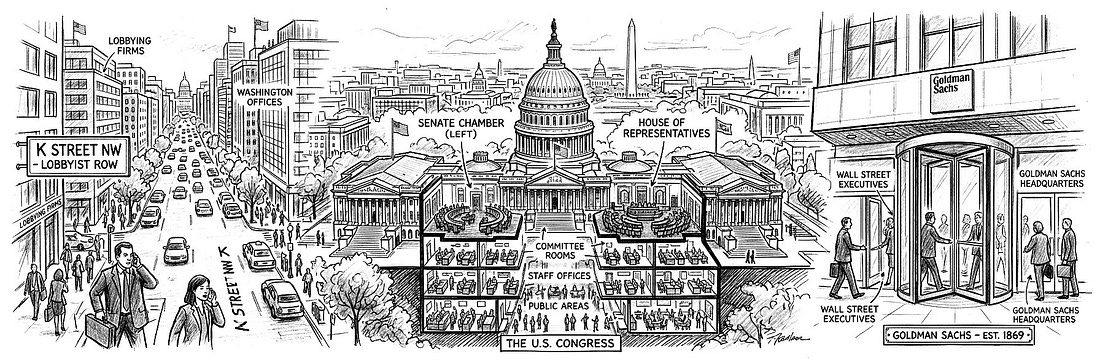
In a previous essay, this space examined how Citizens United v. Federal Election Commission handed corporations the constitutional cover to pour unlimited money into American elections.1 That ruling matters. But it is only the entry point. The deeper problem is what happens after the election, inside the institution that money helped shape. Congress has developed structures, habits, and procedural weapons that systematically reduce its members’ capacity to represent the people who elected them. The result is not dramatic corruption of the kind that fills courtrooms. It is something subtler and more durable: a legislature that struggles to represent its constituents even when individual members wish to do so.
The Fundraising Treadmill In the first weeks of their congressional service, new members of the House are given a schedule. It is not a schedule for legislative hearings or constituent meetings. It is, in significant part, a call sheet. The Democratic Congressional Campaign Committee and the National Republican Congressional Committee both operate call centers near, but not inside, the Capitol building, where House rules prohibit campaign solicitation on federal property. Freshmen are encouraged to spend several hours each day dialing donors. One former Democratic congressman described the experience to the Huffington Post as “miserable” and likened it to working in a “sweatshop.”2 Members of Congress spend, on average, 20 to 30 hours per week fundraising, according to research by Issue One, a nonpartisan reform organisation. Most voters believe that figure is 10 hours or less.3 The typical House member running for reelection in a competitive race in 2024 raised an average of $10,900 per day, up roughly 50 percent from the 2022 election cycle.4 In the Senate, the typical senator who ran for reelection in 2024 raised $11.1 million over the cycle, an average of about $15,300 per day.5 Those sums are not raised from constituents in small increments. They are raised through intensive cultivation of a donor class whose interests frequently diverge from those of ordinary voters.
Members are incentivised to allocate much of their time toward fundraising for themselves and their party. Even those who would strongly prefer to focus on policy solutions find themselves without the bandwidth. This shortage is particularly acute for those with high-level committee and chairmanship responsibilities, the very members who traditionally lead on legislative problem-solving.6 Every committee assignment carries a specific fundraising quota, as the House Freedom Caucus itself acknowledged in guidance to Republican candidates.7 Defenders of the current system argue that fundraising is unavoidable in a democracy: candidates must persuade voters, and persuasion costs money. The argument has merit up to a point. The problem is not that legislators communicate with constituents. The problem is the scale, the imbalance, and the legislative time displaced. A legislature whose members spend roughly half their working hours soliciting money from a narrow donor class is a legislature structurally distracted from the job it was elected to do.
The Revolving Door The fundraising imperative does not operate in isolation. It connects, through a feedback loop of incentives and relationships, to the influence industry that has grown up around Congress.
A 2005 Public Citizen report found that 43 percent of members of Congress who left office between 1998 and 2004 and were eligible to lobby became registered lobbyists.8 Subsequent research confirmed the trend continued. OpenSecrets found that 55 percent of House members joining the influence industry registered to lobby, compared to 40 percent of senators.9 Today, roughly 5,000 lobbyists have disclosed former government positions, approximately nine for every member of Congress.10 The ethical concern is not primarily that former members break laws. Most do not. The concern is structural. A legislator who knows that a lucrative salary at a trade association is available upon retirement, as it was for Rep. Billy Tauzin after he authored drug-pricing legislation benefiting the pharmaceutical industry, operates under a permanent soft incentive to weigh future employers’ interests alongside current constituents’.11 Eighty-two percent of revolving door lobbyists identified by the Center for Public Integrity reported lobbying their former agency or government office after registering.12 Partisan loyalty in government becomes bipartisan access in the private sector.
Term limits are frequently proposed as a corrective. The intuition is sound: members who cannot serve indefinitely have less time to cultivate post-congressional employment relationships. Critics raise a legitimate objection: term limits can transfer power to permanent staff and lobbyists who face no such limits. Both concerns are genuine. A more targeted response might combine modest term limits with significantly longer cooling-off periods before former members may lobby, stronger enforcement of existing restrictions, and mandatory disclosure of employment negotiations begun while still in office.
Pork, Riders, and the Omnibus Among the most visible mechanisms by which organised interests extract value from Congress is the practice of attaching unrelated provisions to must-pass legislation. Earmarks, riders, and pork barrel spending have a long bipartisan history of inserting locally popular projects or ideologically motivated policy changes into bills that have neither the time nor the political space to examine them carefully.
A memorable example: in 2009, President Obama signed the Credit CARD Act, a consumer protection measure regulating abusive credit card practices. Attached to it was an amendment sponsored by Senator Tom Coburn of Oklahoma allowing the carrying of loaded firearms in national parks and wildlife refuges, reversing a decades-old regulation.13 The two subjects had nothing to do with each other. The rider passed because it was attached to a bill that could not be blocked without also blocking credit card reform. That is the logic of the legislative rider: use the political necessity of one bill to carry something that could not survive scrutiny on its own.
Formal earmarks were banned in 2011 under sustained public pressure, only to be reinstated in 2021 under the label “community project funding.”14 The cycle demonstrates both the appeal and the problem. Earmarks are popular with members of both parties because they deliver visible benefits to specific districts. The accountability problem is that attaching them to unrelated bills obscures the legislative record. Transparency requires that legislation address what its title says it addresses.
Agenda Control: The Power Not to Act Democratic theory generally assumes that if a majority of elected representatives support a measure, it can come to a vote. In the House of Representatives, that assumption is frequently wrong.
The Speaker holds substantial control over the legislative calendar, including the practical power to decline to schedule a bill for floor consideration regardless of how many members support it. An informal norm, known as the Hastert Rule after former Speaker Dennis Hastert, holds that the Speaker will not bring a bill to the floor unless a majority of the majority party supports it. The rule appears in no statute; it is a convention of majority-party governance. But its effect is significant: legislation that could pass with bipartisan support but lacks majority backing from the Speaker’s own party can be, and routinely is, left unscheduled.
The most consequential modern example of agenda control being exercised at the Senate level involves Merrick Garland, President Obama’s nominee to fill the Supreme Court seat vacated by Justice Antonin Scalia’s death in February 2016. Senate Majority Leader Mitch McConnell announced within hours of Scalia’s death that the Senate would hold no hearings and no vote on any Obama nominee. Garland waited 293 days without a committee hearing, the longest such wait in modern history, before his nomination lapsed.15 Whether McConnell’s decision was constitutionally defensible is contested. What is not contested is that a president exercised his constitutional nomination power and the Senate’s majority leadership used control of the calendar to prevent any formal response whatsoever.
The Filibuster and Its Nuclear History The Senate filibuster is among the most misunderstood procedural devices in American government. In its traditional form, a filibuster required senators to hold the floor continuously, talking, to delay or prevent a vote. The modern filibuster requires none of that. Under current rules, any senator may signal an intent to filibuster, and that signal alone requires the majority to assemble 60 votes for cloture, the procedural vote to end debate. The practical effect is that the Senate now operates as a 60-vote body for most legislation, despite the Constitution requiring only a simple majority for ordinary bills.
The threshold has been significantly eroded through what practitioners call the nuclear option: a procedure by which a simple majority of senators votes to change Senate rules by simple majority, bypassing the supermajority normally required to alter those rules.
In November 2013, Senate Majority Leader Harry Reid deployed the nuclear option, changing the rules so that lower court and Cabinet nominees could be confirmed with a simple majority rather than the 60- vote threshold.16 On April 6, 2017, Senate Republicans under Majority Leader McConnell extended the nuclear option to Supreme Court nominees, confirming Neil Gorsuch the following day.17 In April 2019, the Senate further reduced postcloture debate time for most nominations.18 The ledger of what has been nuked now includes executive branch nominees, lower federal court judges, circuit court judges, and Supreme Court nominees, all of which require only a simple majority for confirmation. What remains protected by the 60-vote threshold is ordinary legislation.
There is a genuine argument on both sides. The 60-vote requirement forces at least some bipartisan negotiation and prevents a bare majority from overriding minority concerns entirely. Conversely, in a sufficiently polarised Senate, that threshold produces governance by gridlock. Both things can be true simultaneously. The filibuster’s defenders and critics have, with notable consistency, swapped their positions each time the majority changed hands.
The Electoral Map The problems described above operate within a legislature whose composition is itself distorted before a single vote is cast.
Gerrymandering, the practice of drawing district boundaries to favour one party, has existed since Elbridge Gerry signed the Massachusetts redistricting bill of 1812 that gave the practice its name. What has changed in the modern era is precision. Computer modelling and granular voter data now allow mapmakers to construct districts that lock in majority control for a decade with statistical confidence.19 The result is a House in which most members face no competitive general election. Their primary electoral threat comes from their own party’s most motivated voters, which pulls members toward ideological extremes and away from the centre where durable legislation is built.
The Electoral College presents a related distortion. By awarding all of a state’s electoral votes to its popular-vote winner in most states, the College systematically over-weights votes in smaller states and renders votes in safely partisan states functionally irrelevant. A candidate can lose the national popular vote by millions and still win the presidency, as occurred in 2000 and 2016.20 Ranked Choice Voting and the Reform Toolkit One reform that addresses several of these distortions is ranked choice voting. Under such a system, voters rank candidates in order of preference. If no candidate wins a first-round majority, the last-place candidate is eliminated and their votes redistribute to second choices, continuing until one candidate holds a majority.
A candidate who is the first choice of 35 percent of voters but the second or third choice of many others can outperform one who inspires intense support from a narrow base but active opposition from everyone else. Ranked choice rewards broad appeal rather than ideological intensity. Alaska adopted it for statewide and federal elections in 2020. Maine has used it for federal elections since 2018. Both have produced more competitive races without the predicted chaos.21 Ranked choice voting has real limits. It does not redraw gerrymandered maps. It requires voter education and moderately more complex ballot design. It works best as one component of a broader toolkit: independent redistricting commissions that remove mapmaking from legislative control, public financing systems that reduce the fundraising treadmill, and stronger lobbying restrictions that slow the revolving door. California, Arizona, Michigan, and Colorado have established independent or bipartisan redistricting commissions. The evidence from these states suggests that competitive districts produce more moderate representatives and higher voter engagement.22 What Reform Actually Requires The problems catalogued here cross party lines. Democrats and Republicans have used every one of these mechanisms when it suited them. McConnell’s blocking of Garland was preceded by Reid’s deployment of the nuclear option. The Hastert Rule has been selectively applied and abandoned by both parties. Pork has crossed every aisle, in every decade.
What these problems share is not a party. They share a structural logic: each reduces the influence of ordinary citizens and increases the influence of organised, well-funded, procedurally sophisticated actors. They are the accumulated residue of decisions made by people who found these tools useful, without adequate attention to what they were doing to the institution and to the people the institution exists to serve.
Meaningful reform does not require a single sweeping law. It requires movement on several specific, achievable fronts. Mandatory, robust disclosure of all political spending is achievable through statute and has withstood legal scrutiny.23 Public financing pilots at the federal level, modelled on programs in Maine and Arizona, would reduce the structural dependency on large donors.24 Extending congressional cooling-off periods from one or two years to five, and closing the shadow lobbying loophole, would slow the revolving door without banning post-government careers.25 Federal incentives for states to adopt independent redistricting commissions would address the primary extremism pipeline without requiring a constitutional amendment.26 And a Senate rule providing a carve-out from the filibuster for electoral reform legislation, modelled on the existing budget reconciliation carve-out, would allow the majority to act on foundational questions of democratic participation without dismantling minority protections wholesale.
None of these proposals are radical. Each has been introduced in Congress, supported by members of both parties at various points, and defeated not by principled opposition but by the institutional inertia of a system that benefits those who control it. The Constitution opens with three words: We the People. Every structural failure described in this essay represents a departure from that premise. Naming them clearly, without partisan deflection, and insisting on correction is not idealism. It is the oldest American argument there is.