There is a good chance the car you drove to work today burned fuel refined from oil extracted by a method invented in the nineteenth century, ignited by an engine whose fundamental design has not changed since 1876, and priced by a global cartel whose leverage over the American economy has survived every war, every recession, and every promise made by every president since Richard Nixon. Even if you drive an EV, the grid that charged it likely still draws on fossil fuels for a significant share of its power. The energy system underneath our daily lives has not meaningfully changed.
This is not fate. It is inertia. And inertia, unlike physics, can be overcome by choice.
The vision described in these pages is not speculative fiction. Every technology it requires either exists today or is in advanced commercial development. The barriers are not in the laboratory. They are in the lobby. In the paralysis of democratic institutions that were designed for a slower world and have not yet learned to move at the speed the moment demands.
Who This Serves Before the engineering, consider who this future actually liberates.
It serves the 8 million Americans with visual disabilities who cannot hold a driver’s license.1 It serves the 50 million Americans over 70, for whom surrendering a license is not a bureaucratic inconvenience but the loss of independence, dignity, and access to medical care.2 It serves the rural family in Mississippi or Montana for whom there is no bus, no train, and no alternative to a car they cannot afford, a car that requires a license they may not have, on roads where a mistake means death, not a fender bender.
It serves the 37 Americans who die every single day in drunk driving accidents. The number is so consistent, so predictable, and so entirely preventable that its persistence is less a tragedy than an indictment of political will.3 And it serves the climate. Transportation is the single largest source of greenhouse gas emissions in the United States, responsible for 28 percent of total emissions, more than electricity generation, more than industry, more than agriculture.4 Electrifying transportation, powering it from renewable sources, and reducing the number of vehicles on the road through shared autonomous fleets could cut that figure faster than almost any other single intervention available to policymakers today.
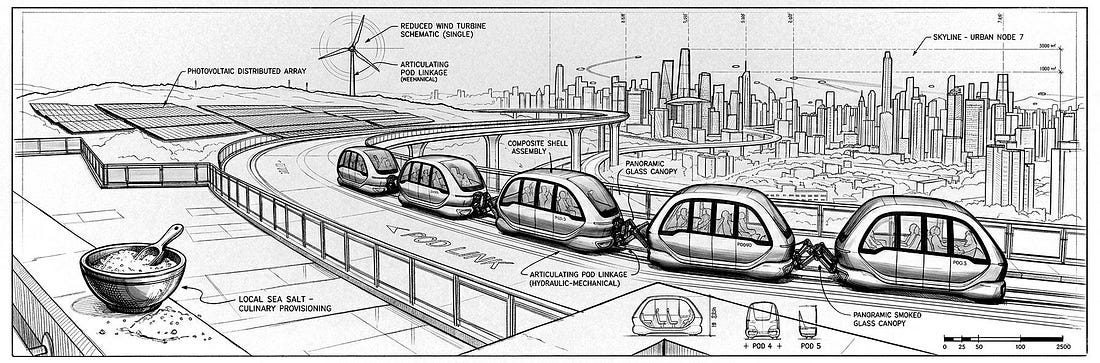
The Vision Imagine a morning commute that begins not with a search for parking or a frustrating merge onto a congested highway, but with a quiet pod, a four-passenger autonomous cabin, that arrives at your doorstep, recognizes you, and departs. In the city, it navigates independently, smoothly, without the stop-and-go aggression of human-driven traffic. As it reaches the freeway, it does something no individual car can do: it joins a train.
Other pods traveling the same direction, at the same speed, couple into a convoy, separated by inches rather than car lengths, moving as a coordinated unit through aerodynamic drag reduced by 30 to 40 percent.5 Embedded in the freeway beneath them, inductive coils transfer power wirelessly to the moving convoy, topping up batteries continuously, eliminating the range anxiety that has shadowed electric vehicles since their commercial introduction.6 At the destination exit, the pod disengages from the train and completes the last mile alone.
When not carrying passengers (which is most of the time, since the average American vehicle sits idle 95 percent of its life) the pod parks at a charging station and does something revolutionary: it gives energy back. Millions of parked pods, their sodium-ion batteries topped from solar arrays and wind farms, form a distributed storage network of continental scale. The sun charges the fleet. The fleet charges the grid. The grid charges the road. The road charges the pod. The system breathes.
This is not one technology. It is an ecosystem. And ecosystems, once they reach critical mass, become self-sustaining.
The Technology Is Ready The skeptic’s first instinct is to reach for the word “futuristic.” The facts do not support it.
Autonomous vehicles already operate commercially in American cities. Waymo completed over four million fully driverless rides in 2024, operating without safety drivers in geofenced areas of San Francisco, Phoenix, and Los Angeles, and is expanding to new markets.7 Vehicle platooning, the highway train concept, has been demonstrated at scale by Peloton Technology, Volvo, and Scania, with fuel savings confirmed in real-world commercial deployments.8 Wireless road charging is operational on public streets in Detroit and is under construction in Florida, Indiana, and across Sweden, France, and South Korea. In October 2025, a 1.5-kilometer stretch of the French A10 highway transferred 300 kilowatts to vehicles moving at highway speed, a single-corridor trial with important limitations but also a proof of concept that even the most skeptical engineers called significant.9 Vehicle-to-grid technology, the mechanism by which a parked pod returns electricity to the grid, is already in commercial deployment. Ford’s F-150 Lightning and several Nissan and Volkswagen models support bidirectional charging. Utilities in California, Texas, and the United Kingdom are running active pilots in which EV fleets provide grid balancing services. These pilots currently involve tens of thousands of vehicles; scaling to the hundreds of millions needed for a true national storage network will require regulatory reform, interconnection standards, and sustained investment.10 The battery chemistry that makes this economically viable is arriving now. Sodium-ion batteries, which replace lithium with sodium, an element as common as salt and found in inexhaustible quantities in seawater, have reached commercial production at CATL’s facilities in China, with the first sodium-powered passenger vehicles entering the market in mid-2026.11 These cells achieve over 10,000 charge cycles, nearly three times the lifespan of the best lithium chemistry available today. Their energy density of around 175 Wh/kg is lower than premium lithium chemistries, making them better suited to fleet and grid storage applications than to high-performance long-range vehicles. But for the pod use case, where cycle life and cost matter more than maximum range, the tradeoff is favorable. They also operate stably from minus forty degrees Celsius to plus eighty, without the thermal runaway risk that caused the Moss Landing, California grid-storage fire in January 2025, an incident rooted in specific lithium iron phosphate grid-scale conditions and a reminder that battery system design matters as much as chemistry.12 The raw material cost of sodium is approximately three hundred times cheaper than lithium per kilogram. Once sodium-ion production reaches the scale that lithium-ion has accumulated over three decades, the cost advantage is poised to flow directly to the consumer. The battery of the future is not a rare earth mineral extracted from the Atacama Desert or the contested soil of eastern Ukraine. It is, in the most literal sense, table salt.
The Obstacle Is Not Technology Here is the uncomfortable truth that no amount of engineering optimism can avoid: we have known, in broad outline, what a sustainable transportation future looks like for at least two decades. Solar power, electric vehicles, battery storage, and autonomous driving have been on the research agenda since before the first iPhone. The reason we are not further along is not that the problems proved harder than expected.
It is that the problems proved profitable. For the people with the most influence over the pace of their own disruption.
The American Petroleum Institute spent $66 million on lobbying in 2024 alone, one of the five largest lobbying expenditures in Washington that year.13 The traditional automotive industry, whose dealer networks, parts suppliers, and financing arms depend on the complexity of the combustion engine, has used every available legal mechanism to slow the regulatory transitions that would accelerate the shift to simpler, cheaper electric drivetrains. The utilities, facing the disruption of distributed generation and vehicle-to-grid storage, have in many states successfully lobbied to restrict the feed-in tariffs that would make V2G economically attractive to consumers.
None of this is conspiracy. It is rational behavior by institutions acting in their own short-term interest. The problem is that the short-term interest of incumbent industries and the long-term interest of the country are not merely different. They are, on this issue, directly opposed.
The Transition Is Where the Battle Is Fought A question that deserves more honest attention than it typically receives: even if the vision is correct, how do we get from here to there?
The United States has 290 million registered vehicles, almost all of them combustion-powered.14 It has 145,000 fuel retail outlets and a distribution system of continental scale, built over a century.15 It has millions of workers whose livelihoods depend on maintaining, fueling, and insuring those vehicles. A just transition requires not just new infrastructure but workforce retraining programs, community investment in regions dependent on fossil fuel employment, and supply- chain policy that ensures the jobs of the new economy are not simply offshored to wherever batteries are cheapest to assemble. You cannot switch off the existing system on a Tuesday and start fresh on a Wednesday, and pretending otherwise guarantees a backlash that sets the whole project back.
The transition, not the destination, is where the difficulty actually lives. It is also where the policy imagination has been most impoverished.
The path is not a single switch but a long ramp, and the ramp must be engineered as deliberately as the destination. Controlled environments first: corporate campuses, university districts, airports, and new suburban developments where infrastructure can be designed pod-first rather than retrofitted around a century of combustion assumptions. Then specific highway corridors, where road charging investment can be justified by committed fleet volumes. Retrofitting even a modest network of high-traffic corridors with inductive charging coils is likely to require tens of billions of dollars in combined public and private investment, significant but small relative to the long-term cost of continuing to build infrastructure around combustion. Then the broader network, as economics and familiarity combine to accelerate adoption.
The combustion fleet does not need to be banned to disappear. It needs only to become, year by year, the more expensive, less convenient, less insurable, and less desirable option. When the autonomous pod arrives faster, costs less per mile, requires no parking, and returns money to its owner while sitting idle, the market will finish the argument that regulation started.
But market forces move on market timelines. The climate does not negotiate timelines. This is the central tension that no amount of optimism resolves: the physics of atmospheric carbon accumulation does not pause while democratic institutions deliberate.
What Honest Progress Looks Like Progress on this scale has never been linear and has never been led by the most powerful incumbents in the room. It has been led by the erosion of the economic case for the status quo, which is already underway, and by the emergence of alternatives too cheap and too good to ignore.
Solar electricity is today the cheapest form of energy ever produced in human history.16 Sodium-ion batteries are poised to undercut lithium chemistry on cost per kilowatt-hour within the next few years as production scales. Autonomous driving software improves on a curve that makes human reaction times look increasingly like a liability rather than a baseline. The road charging infrastructure being built in Sweden and France could demonstrate, at scale, that the freeway itself is a charging network.
Each of these developments makes the next one more economically compelling. The ecosystem, once sufficiently assembled, becomes self- reinforcing. The question is not whether this future arrives. It is whether it arrives in time to matter, and whether the United States leads it or spends the next two decades importing the technology, at great cost, from the country that chose to build it first.
The policy agenda is not complicated. Federal matching funds for pod- first corridor pilots. A national V2G interconnection standard so parked vehicles can actually talk to the grid. Liability rules that clarify responsibility in platooning deployments. Procurement targets that require public fleets to lead adoption. Workforce transition grants for communities dependent on the combustion economy. These are not radical proposals. They are the kind of coordinated industrial policy that every other major economy already uses, and that the United States deploys selectively when the political will exists.
The road ahead is not a mystery. It has been mapped, in remarkable detail, by engineers, economists, and urban planners who have spent careers on exactly these questions. What it lacks is not knowledge. It lacks the political condition that allows knowledge to become policy: a public that understands what is possible, insists on it, and holds accountable those whose financial interest lies in persuading them that it is not.
Systems built by human choices can be rebuilt by different ones. The pod waiting at your door is not a fantasy. It is an engineering problem that has largely been solved. What remains is a harder problem entirely, the one that has always been harder: persuading people with power to relinquish the advantages of the world that exists, in favor of the one that should.
The battery that makes it all possible is sitting in your kitchen cabinet right now.
Salt. Don’t eat it. Charge it.