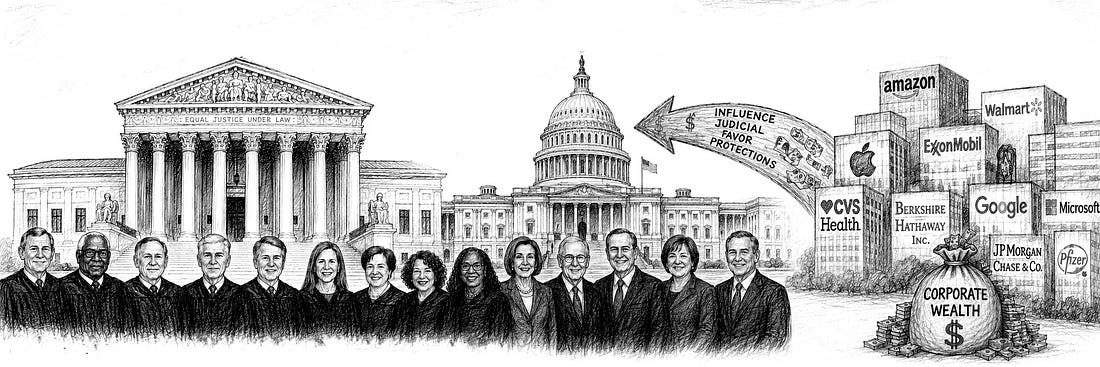
In 2008, Justice Antonin Scalia wrote the majority opinion in District of Columbia v. Heller, affirming an individual’s right to keep and bear arms. His reasoning was rooted in originalism: the principle that the Constitution means what its framers intended it to mean. The text matters. History matters. The purpose behind the words matters. It was a landmark application of that judicial philosophy, and it established a method that Citizens United, decided just two years later, would claim to follow.1 The problem is that the method, applied consistently, points in the opposite direction.
In Citizens United v. Federal Election Commission, the Court held, five to four, that corporations possess First Amendment free speech rights equivalent to those of individual citizens, and that limiting their political spending therefore violates the Constitution.2 The ruling has reshaped American elections ever since. Outside spending, which totalled roughly $750 million in the 2008 cycle, surpassed $3.3 billion in 2020 and exceeded $2.8 billion in the 2022 midterms.3 That money does not arrive neutrally. It arrives with interests attached.
The case deserves a serious constitutional reckoning, one that engages honestly with the strongest arguments on both sides. When that reckoning is done carefully, the conclusion is difficult to avoid: Citizens United was wrongly decided, not merely as a matter of policy, but as a matter of constitutional law.
What the Court Decided, and Why The case arose from a modest dispute. Citizens United, a conservative nonprofit, produced a film critical of Hillary Clinton during the 2008 primary season and sought to advertise it close to the election. Federal law at the time, specifically the Bipartisan Campaign Reform Act of 2002 (known as McCain–Feingold), prohibited corporations and unions from using their general treasury funds to pay for “electioneering communications” within thirty days of a primary or sixty days of a general election.4 The question before the Court was narrow: could Citizens United air its film and advertisements under those restrictions?
The Court answered that question, and then went considerably further. Writing for the majority, Justice Anthony Kennedy held that political speech does not lose constitutional protection simply because its source is a corporation rather than an individual. To restrict corporate spending on political speech, he argued, is to restrict speech itself, and the First Amendment admits no such distinction based on the identity of the speaker. The government, Kennedy wrote, has no legitimate interest in limiting political speech based on the corporate identity of those who fund it.5 It was a bold ruling, resting on a coherent legal principle: speech is speech, regardless of who pays for it, and the First Amendment’s command protects even deeply unpopular or heavily funded expression.
The Case for Citizens United Those who defend the ruling make arguments that deserve to be heard on their own terms.
The most straightforward is the anti-censorship argument. The First Amendment exists precisely to prevent the government from deciding which voices are permitted in the public square. If Congress can silence a corporation’s political speech because it disapproves of the source, what prevents it from silencing a newspaper, a union, or an advocacy group on the same grounds? A government empowered to regulate speech based on the speaker’s identity is a government with enormous potential for abuse.6 A second argument concerns the mechanics of communication. Ideas do not travel on their own. They require printing presses, broadcast towers, websites, and advertising budgets. Spending money to disseminate a political message is not separate from the message itself; it is the mechanism by which the message reaches anyone at all. To prohibit spending is, in this view, to prohibit speech at its point of delivery.7 A third argument is associational: corporations are composed of people, including shareholders, employees, and communities, who have legitimate collective interests in the political process. Denying corporations any First Amendment standing arguably denies those individuals a vehicle for collective expression, while leaving media companies and advocacy nonprofits fully protected.8 These are serious arguments. They reflect a genuine and longstanding tradition of robust free speech protection in American law.
Where the Originalist Framework Points The majority in Citizens United claimed the mantle of originalism. But that claim does not survive scrutiny. The strongest textualist defense of the ruling holds that the First Amendment’s phrase “no law” is unqualified, and that because associations of individuals have historically enjoyed some speech protections, corporations should too. Justice Scalia pressed exactly this argument in his concurrence, contending that reading the Amendment to exclude corporate speakers imports a distinction the text does not draw.9 The difficulty is that this argument proves far too much. The founding generation did recognize some associational speech, but the modern for-profit corporation, chartered by the state and shielded from personal liability, is a creature of the nineteenth and twentieth centuries, not the eighteenth. There is no reliable historical evidence that the ratifiers of the First Amendment understood it to grant general political rights to such entities. What historical evidence does exist points the other way: early American law imposed strict limits on corporate activity, treating corporate charters as narrow grants of public privilege rather than bundles of constitutional rights.10 To invoke originalism in defense of unlimited corporate political spending is not to follow the founding; it is to project present-day corporate power onto a constitutional text that predates it.
The more principled application of Heller’s own method reaches a different result. In Heller, Scalia asked whose right the Second Amendment was written to protect and answered: the individual citizen, based on text, history, and purpose. Ask the same question of the First Amendment and the same answer emerges. The free speech guarantee was written to protect citizens, not legal constructs. A corporation cannot vote. It cannot be conscripted. It bears none of the obligations of citizenship. Extending it the same First Amendment standing as a natural person is not what the text demands; it is a policy choice dressed in constitutional language.11 The Structural Contradiction The deeper constitutional problem is structural, not merely historical.
The First Amendment protects speech so that democracy can function. It guarantees that citizens can express their views, criticize their government, assemble in common cause, and participate in the contest of ideas that self-governance requires. The right is instrumental: it exists in service of democratic participation. When the Court ruled that unlimited financial expenditure is protected speech, it did not expand that function. It undermined it.12 Consider what this looks like in practice. In the 2014 North Carolina Senate race, outside groups spent over $100 million, most of it from sources not required to disclose their donors under post-Citizens United rules.13 Individual voters in North Carolina contributed a small fraction of that total. Their speech was not silenced. It was simply rendered insignificant by orders of magnitude. That is not a functioning marketplace of ideas. It is a marketplace with one very well-capitalised vendor.
There is a distinction the majority failed to make: speech that participates in democracy and spending that overwhelms it are not the same constitutional act. In the decade after Citizens United, the top 100 donors to Super PACs contributed roughly as much as 4.75 million small donors.14 The First Amendment cannot logically be used to silence the very citizenry it was written to protect.
The Counter and Its Limits A defender of Citizens United might respond that the answer to a well- funded message is a better counter-message, not a government restriction on the original. This is a venerable principle with deep roots in First Amendment tradition.15 But the counterspeech doctrine assumes competitors with some rough parity of reach. When one side of a political debate can spend a billion dollars and the other cannot approach that figure, the doctrine becomes a rationalization for permanent structural imbalance rather than a description of how discourse actually works. Political scientists Martin Gilens and Benjamin Page analyzed 1,779 policy outcomes and found that the preferences of average citizens have “little or no independent influence” on policy, while economic elites and organized business interests do.16 More speech has not been enough.
Nor does the absolutist position address the existing landscape of speech regulation. Defamation law, perjury statutes, securities regulations, and disclosure requirements all restrict certain speech for the public good without serious constitutional objection.17 The question has never been whether speech can be regulated, but which regulations serve legitimate public interests. Protecting the integrity of democratic participation is precisely that kind of interest.
What the Court Should Do The Supreme Court has corrected itself before. Plessy v. Ferguson stood for fifty-eight years before Brown v. Board of Education recognized it for what it was.18 Precedent is not permanence.
The path forward has several lanes. Statutory reforms that stop short of overturning Citizens United remain viable: robust donor disclosure requirements, shareholder approval mandates for corporate political expenditures, and public financing systems that amplify small-dollar donors have all survived or could survive current precedent.19 States have also served as laboratories: Maine and Arizona have run public financing programs that demonstrably increase candidate diversity and reduce dependence on large donors.20 At the doctrinal level, a future Court need not fully overturn Citizens United to restore meaningful limits. It could narrow the ruling by distinguishing between direct corporate treasury expenditures and genuine associational advocacy, or by revisiting the line of cases holding that contribution limits and expenditure limits must be treated identically. And should a constitutional amendment eventually prove necessary, the Twenty-Fourth Amendment offers a precedent: it overturned the poll tax upheld by prior case law, demonstrating that constitutional correction of a mistaken judicial course, though slow, is not impossible.21 A future Court, applying the originalist framework with the consistency Scalia demanded in Heller, would ask whose rights the First Amendment was written to protect. The answer is citizens. Not chartered legal fictions. Not concentrations of private capital wearing the mask of speech. Citizens.
Free speech is not the loudest voice winning. It is every voice having a fighting chance. Citizens United forgot that. The Constitution, read honestly, remembers it.