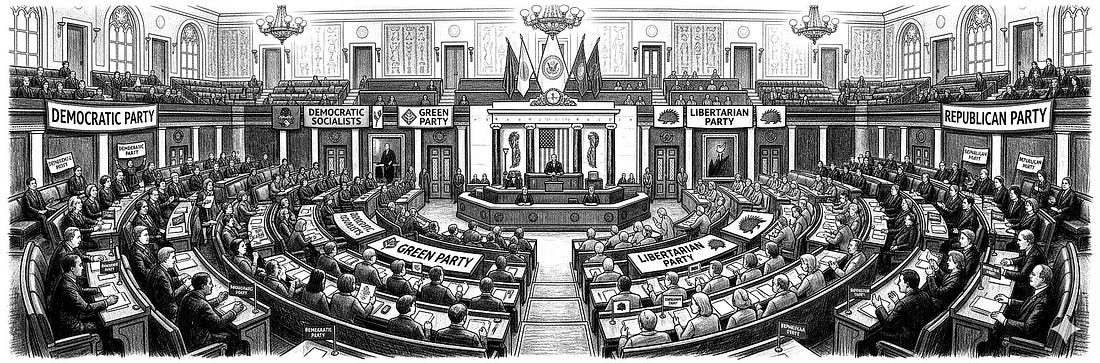
A Warning From the Beginning The Constitution of the United States does not mention political parties. Not once. The framers who drafted it had read their history. They knew what factions did to republics, and several of them said so with unusual directness.
In his Farewell Address of 1796, George Washington devoted its longest single passage to a subject that had nothing to do with foreign policy: the danger of partisan division. He warned the young republic against the “baneful effects of the spirit of party generally,” calling it in popular governments their “worst enemy.”1 He was not speaking abstractly. He had watched two factions harden around Hamilton and Jefferson while he was still in office, and he knew what came next. Political parties, he wrote, would become “potent engines, by which cunning, ambitious, and unprincipled men will be enabled to subvert the power of the people.”2 He described partisan domination, sharpened by “the spirit of revenge natural to party dissension,” as itself “a frightful despotism.”3 James Madison had arrived at the same conclusion a decade earlier, warning in Federalist No. 10 about the “violence of faction” as the principal threat to republican government. The Constitution itself was partly designed to contain it.4 These men were not naive idealists. They were architects who had studied collapsed republics firsthand. Washington’s Farewell Address was not a nostalgic lament. It was a diagnosis. Two hundred and thirty years later, the patient is showing every symptom he described.
Two Jerseys, Three Hundred and Forty Million People The core problem with a two-party system is not that people disagree. Disagreement is the engine of democratic deliberation. The problem is that two rigid bundles cannot contain the full range of views held by a nation of three hundred and forty million people spanning fifty states, dozens of major industries, hundreds of distinct regional cultures, and every conceivable combination of values.
The duopoly demands that each voter accept a package deal. You do not get to favor a strong national defense and a single-payer healthcare system, environmental regulation and lower business taxes, criminal justice reform and secure borders, without being accused of betrayal by one tribe or the other. The party platform is not a reflection of your views. It is a loyalty test. And loyalty tests, by design, do not produce nuanced governance. They produce tribalism.
The electorate knows this. According to Gallup, a record 45 percent of American adults identified as political independents in 2025, the highest figure in the history of the survey, while both the Republican and Democratic parties stood tied at 27 percent each.5 The single largest group of voters in the United States belongs to neither party. That cohort is growing fastest among the young: 56 percent of Gen Z adults now identify as independents, compared to 47 percent of millennials in 2012 and 40 percent of Gen X adults in 1992.6 Each successive generation is less willing to wear a jersey. The parties’ entry rules are designed to ensure that rejection has no political consequence.
This is not a complaint about the existence of parties in general. Parliamentary democracies around the world operate with multiple parties, and most of them manage the business of governing more productively than Washington has managed it in recent decades. The problem is specifically the duopoly: two parties that have structurally locked out all competition and that derive much of their organizational energy not from ideas but from hostility toward each other.
The Rigged Playing Field The two major parties do not merely compete within the electoral system. They design it. State legislatures, overwhelmingly controlled by one party or the other, write the ballot access laws that determine whether any other candidate can appear before voters at all. The rules they have written serve incumbency, not democracy.
In Georgia, a statute dating to 1943 required independent and third- party candidates to collect petition signatures from five percent of all registered voters before their names could appear on any ballot. In a state with millions of registered voters, that threshold was never once cleared in roughly 800 congressional races over eight decades, until a federal court ruled the provision unconstitutional as recently as 2021.7 Florida has imposed filing fees calibrated to seven percent of an office’s annual salary for non-major-party candidates, a sum exceeding eight thousand dollars for a congressional seat.8 In New Mexico, an independent candidate for a single congressional district must gather more than four thousand valid signatures; a Republican candidate for the identical seat needs fewer than eight hundred.9 These are not incidental disparities. They are the system’s immune response to outside competition.
The structural problem runs deeper than ballot access. The United States uses winner-take-all, or first-past-the-post, voting in virtually all its federal and state elections. Under this arithmetic, a party that earns seven percent of the national vote wins zero congressional seats. In a proportional representation system with a reasonable entry threshold, that same seven percent translates into roughly seven percent of legislative seats, a foothold from which new ideas and minority viewpoints can actually influence policy.10 Most Western European democracies and many Commonwealth nations have moved away from pure first-past-the-post at the national level, though the United Kingdom remains a significant exception that demonstrates the risks of backsliding. The United States has not moved at all, and one reason is structural: the two parties who benefit from winner-take-all control the legislatures that would need to change it.
Team Sport, Not Governance Consider what it means, in practical terms, that Congress is organized entirely around two opposing teams. Every committee chairmanship, every floor priority, every procedural maneuver is allocated based on which team controls the chamber. The incentive facing every member is not to solve the country’s problems. It is to hold the line for their side and deny the other side a win, because a win for the other side can be used against you in the next campaign.
This is not a description of dysfunction. It is a description of the system working exactly as its incentive structure demands.
When Congress could not agree on a debt ceiling increase in 2011, it was not because the underlying fiscal questions were unresolvable. It was because one party’s leadership explicitly treated the vote as a leverage moment to extract concessions from the opposing White House, framing the full faith and credit of the United States as a bargaining chip in an ongoing team competition.11 The country’s credit rating was downgraded for the first time in its history.
Political scientist Sarah Binder’s systematic research on legislative gridlock documents the mechanism clearly: as partisan polarization increases, the probability of gridlock on any given legislative proposal rises, and the capacity for cross-party coalition-building collapses.12 The result is a Congress structurally impaired from addressing what majorities of Americans, across party lines, consistently tell pollsters they want addressed: infrastructure investment, prescription drug pricing, paid family leave, anti-corruption reform. The legislation does not pass because passing it would require giving the other side a win, and in a two-team game, you do not help the other side score.
Think of it as two football teams that have no choice but to fight and dominate each other. No team wins by helping its opponent score. And so the country’s business does not get done, because doing the country’s business looks too much like losing.
The Manufactured Enemy The tribal hostility characterizing American politics today is not simply organic disagreement made visible. It is, in substantial part, a product. Outrage is profitable. Research on media incentives shows that cable news channels discovered conflict drives ratings; social media platforms found that anger generates engagement and time-on- platform; and political fundraising operations have learned that nothing opens a donor’s wallet faster than a sufficiently frightening villain on the other side.13 The result is what political scientists call “affective polarization”: citizens who do not merely disagree with their opponents on policy, but who actively dislike and distrust them as people. Pew Research Center data shows that sharply unfavorable views of the opposing party have roughly doubled over the past decade among both Republicans and Democrats.14 Most of the electorate, however, still holds a mix of positions that neither party’s current platform represents well. The polarization is sharpest and most consequential at the elite level, among the activists, donors, and officeholders who shape party behavior, not among ordinary voters who remain considerably more ambivalent.15 Washington foresaw the mechanism. He wrote that partisan conflict would produce a “spirit of revenge, natural to party dissension,” and that the disorders of partisanship would “gradually incline the minds of men to seek security and repose in the absolute power of an individual.”16 The performance of mutual hatred serves the parties’ organizational survival. Without an enemy, the base does not mobilize. Without a crisis, the fundraising slows. The enemy is not incidental to the duopoly’s operation. It is essential to it.
A Different Vision I will confess a preference that goes beyond structural reform. Given the choice, I would rather vote for a person than a party. Not for a platform committee’s bundled positions, but for an individual whose judgment I trust, whose record I can examine, and whose character I can assess. The principle is simple: practical solutions to specific problems should be derived from evidence and honest deliberation, not from the pre-existing position of one’s team. Political parties, by their nature, invert this. They begin with the answer and work backward to the argument.
Consider three politicians who have, at different moments, demonstrated what that looks like in practice. Pete Buttigieg, whose ability to articulate complex policy in plain language consistently produced more light than heat. Andy Beshear, a Democrat who wins re- election in one of the nation’s most reliably Republican states by governing competently and refusing the tribal script. Liz Cheney, a conservative by any serious measure, who paid a substantial political price for choosing institutional principle over party loyalty when the moment required it. None of these figures fits neatly into a jersey. That, I would argue, is precisely the point. The capacity for independent judgment is not a weakness in a representative. It is the job description.
I recognize that parties will not disappear, nor need they entirely. The question is whether they must be organized as two mutually hostile monopolies, each more committed to defeating the opposition than to governing the country. They need not be.
What Works Elsewhere, and What Works Here Since 1937, Nebraska has operated the only officially nonpartisan state legislature in the United States. Party labels do not appear on the ballot. Legislative leadership is not allocated by party affiliation. The two candidates earning the most votes in the primary meet in the general election regardless of their registration. Senator George Norris, who championed the reform, argued that national party lines often have little to do with local governance, and that a voter who follows the party label may well be voting for a candidate whose actual positions contradict their own interests.17 After nearly ninety years of operation, the Nebraska unicameral consistently ranks among the most efficient state legislatures in the country, with lower operational costs, mandatory public hearings for every bill introduced, and a formal structure that encourages senators to vote on the needs of their constituents rather than the demands of a national party apparatus.18 The international record is similarly instructive. In the Netherlands, any party clearing approximately 0.67 percent of the national vote earns a seat in parliament.19 Twenty-seven parties contested recent Dutch elections. No single party has ever won a parliamentary majority, which means governing requires building coalitions: negotiating with yesterday’s opponent to become tomorrow’s partner. Germany uses a mixed-member proportional system with a five-percent threshold specifically designed to prevent fragmentation while still allowing meaningful representation of minority viewpoints.20 That threshold, a standard feature of well-designed proportional systems, is the guardrail that addresses the legitimate concern about extremist parties gaining representation: a reasonable entry bar excludes fringe movements while still breaking the duopoly’s monopoly on power.
These are not exotic experiments. They are the standard operating procedure of most established democracies. The United States is the outlier, not the model.
The Path Forward Dismantling the duopoly does not require a constitutional convention. Most of the structural rules that sustain it are statutory and largely state-level, within reach of the reform movements that have already begun to move.
Ranked-choice voting, discussed at length in a previous piece in this series, directly addresses the spoiler effect that has kept alternative parties from gaining a foothold for a century.21 When voters rank candidates in order of preference, a vote for a candidate outside the two major parties no longer risks handing victory to the candidate you like least. Maine has used ranked-choice voting in federal races since 2018. Alaska adopted it and promptly elected a moderate to a House seat that had been captured by an extreme wing of one party. Voters in several states can currently push RCV adoption through ballot initiative without waiting for the state legislature to act.
Proportional representation for congressional seats would require more significant reform and raises genuine constitutional questions about apportionment and Article I that would need to be addressed through federal legislation.22 The goal is not to import any single foreign system wholesale but to break the arithmetic that converts a narrow plurality into a functional monopoly on power. Seven percent of the national vote, under a well-designed proportional system with an appropriate entry threshold, should produce meaningful representation, not nothing. Critics reasonably point to the risk of coalition instability: Italy’s history of frequent government collapses under proportional systems is a legitimate cautionary example. The answer lies in the threshold and in the institutional design, as Germany’s relative stability demonstrates, not in rejecting proportionality altogether.
Open primaries, in which all voters regardless of party registration participate and the top vote-getters advance to the general election, reduce the grip of the party base on candidate selection. When candidates no longer face an ideologically activated primary electorate, the incentive to perform for the extreme recedes. California and Washington State operate top-two open primary systems; Alaska’s version feeds into its ranked-choice general election. These are replicable models, not theoretical proposals.
The resistance to all of these reforms is real and well-funded. The parties that benefit from the current system control most of the legislatures that would need to enact the changes. Where the legislature is not accessible, the ballot initiative is. Where federal change is not yet plausible, state demonstration projects build the record. The arc of reform is there. It requires building the coalitions, in the original sense of that word, to follow it.
The Country, First There is a question worth sitting with at the end of this argument: when was the last time a major piece of legislation passed because it was good for the country, without the calculation of whether it also handed the opposing party a victory?
The framers imagined a republic in which citizens sent their best representatives to deliberate in good faith on behalf of the common good. They did not imagine permanent professional organizations whose survival depends on permanent mobilization, permanent fundraising, and the permanent demonization of the other half of the electorate. Washington warned that parties would allow cunning and unprincipled men to “subvert the power of the people and usurp for themselves the reins of government, destroying afterwards the very engines which have lifted them to unjust dominion.”23 We ignored the warning. We built the machine he described. And now we have a legislature that cannot pass a budget without a crisis, a political culture that treats half its citizens as enemies, and a growing plurality of the electorate that has simply concluded that neither side represents them.
The duopoly is not an accident of history. It is a structure, sustained by law, by money, and by the incentives of those who benefit from it. Structures can be changed. The question is whether we decide, at last, that the country comes first.