A Warning From the Beginning There is a conversation that serious people in this country keep avoiding. Not because the topic is too radical, but because its implications are too large, and because admitting the problem requires acknowledging that the American system, for all its genuine greatness, has developed a structural flaw that will not fix itself.
Start with what is not in dispute: capitalism works. It works better than any alternative human beings have yet devised. The Soviet experiment is over. Venezuela is a cautionary tale. The Nordic social democracies that progressives cite with such admiration are themselves capitalist economies: heavily regulated, generously funded, but built on the same foundation of market competition, private property, and price signals that drive the American system. The debate is not about capitalism versus something else. The debate is about what kind of capitalism we want, and whether we have the political will to make it work for more than a fortunate fraction of our population.
That fraction has grown uncomfortably thin.
The Gap No One Talks Straight About The numbers are not abstractions. A young American who earns a bachelor’s degree today graduates carrying an average of $35,600 in student loan debt.1 A master’s degree carries a total average debt of $69,140.2 A physician begins her career with a median of $200,000 in medical school debt alone, before accounting for the undergraduate loans that preceded it.3 She will spend a decade servicing those obligations while simultaneously building a life, saving for retirement, and raising children who will cost her more than $1,100 per month each in center-based childcare.4 These are the predictable expenses of any family in the United States. But if you are unlucky enough to experience serious illness, medical and hospital bills can set you up for personal bankruptcy. A landmark 2009 study by researchers at Harvard Law School and Harvard Medical School, published in the American Journal of Medicine, found that 62% of all personal bankruptcies in 2007 were medical in origin, and that 78% of those filers carried health insurance when they first got sick.5 Not the uninsured. Not the reckless. People who thought they were protected.
Contrast this with the standard of life available to a working family in Germany, Denmark, or France. Universal healthcare: no bankruptcy for a cancer diagnosis. for a cancer diagnosis. Free or heavily subsidized university education. Thirty days of guaranteed paid annual leave, by law. Up to two years of parental leave with job protection. Subsidized childcare. These are not utopian fantasies. They are operating realities in economies that are, to repeat the point, capitalist.
The honest question is not whether America can afford these things. The question is why America, the wealthiest nation in the history of human civilization, has chosen not to provide them.
The Machine at the Door Do not be misled by aggregate employment statistics. They mask a structural transition already underway.
Artificial intelligence and automation are not merely improving productivity at the margins. They are displacing categories of work that have historically anchored the middle class. Goldman Sachs Research estimates that current AI systems can match or outperform up to 47% of industry professionals on a defined set of economically valuable tasks.5 The World Economic Forum’s 2025 Future of Jobs Report found that 41% of employers globally plan workforce reductions specifically attributable to AI within the next five years.5 McKinsey Global Institute projects that 12 million Americans will need to switch occupations by the end of this decade.5 The pace matters as much as the scale. Where previous industrial revolutions unfolded over generations, AI adoption is compressing transformation into years. Companies that spent 2023 and 2024 experimenting are now executing.
The affected roles extend beyond those you might expect. Yes, data entry clerks and customer service workers are vulnerable. So are junior software developers: employment among Americans aged 22 to 25 in AI-exposed tech roles fell nearly 20% from their late-2022 peak through 2025.5 So are junior lawyers performing legal research, accountants processing financial data, and entry-level analysts whose work has been substantially automated by existing tools. The entry-level positions that once served as training grounds for the professional class are disappearing faster than the senior positions that require them as prerequisites.
Two important caveats deserve acknowledgment. Goldman Sachs estimates that if current AI use cases were expanded across the existing economy, roughly 2.5% of U.S. employment would face outright displacement, significant but not catastrophic in the near term.5 History also offers grounds for measured optimism: 60% of the jobs that exist today did not exist in 1940.5 New categories of work tend to emerge from technological transitions, even when they do not emerge fast enough or in the right places for every displaced worker.
The disagreement is not about whether displacement will happen. It is about speed, geographic concentration, and whether political and social systems will adapt quickly enough to manage the transition humanely. The honest conservative response to this reality is not denial. It is preparation.
The Case for UBI: Made to Skeptics “It costs too much.”
Gross figures make the headline case for alarm: providing $1,500 per month to every American adult would cost approximately $4.7 trillion annually, against total federal revenues of roughly $4.9 trillion. But gross cost is not the relevant figure. The relevant figure is net new spending: what a phased UBI program costs after accounting for what it replaces and how it is funded.
Consider what the federal government currently spends on means- tested welfare programs: approximately $1.5 trillion annually across more than 80 programs administered by eight different agencies.5 This system is administratively expensive, often stigmatizing to recipients, and riddled with the perverse incentives conservatives have criticized for decades: benefit cliffs that punish people for earning more, bureaucratic gatekeeping that screens out those who need help, work disincentives baked into phase-out structures.
A well-designed UBI that consolidates a substantial portion of this spending into a direct cash transfer reduces administrative overhead, eliminates bureaucratic redundancy, and replaces dozens of overlapping programs with a single, transparent floor. Milton Friedman proposed exactly this logic through his negative income tax in the 1960s.5 Charles Murray made the same argument in In Our Hands in 2006.5 The conservative intellectual case for replacing the welfare maze with a direct cash mechanism predates every progressive UBI proposal by decades.
Welfare consolidation alone does not pay for $4.7 trillion. A responsible proposal therefore adds two mechanisms: a displacement levy on corporations for productivity gains exceeding a defined threshold, indexed to the wage base of the positions that generated those gains, a cleaner proxy than counting displaced jobs one by one; and a phased rollout beginning with adults below median income, scaled upward over 10 to 15 years as levy revenues grow.
“It will discourage work.”
The evidence is more contested than either side admits. A 2024 NBER study of unconditional cash transfer programs in Texas and Illinois found modest reductions in labor supply: recipients were roughly four percentage points less likely to be employed.5 This deserves honest acknowledgment.
It is not, however, the whole picture. Finland’s two-year national basic income experiment (2017 to 2018) found a mild positive effect on employment: recipients worked an average of six more days per year than the control group, along with substantially improved mental health, financial confidence, and reported wellbeing across every measure studied.5 Stockton, California’s SEED pilot (2019 to 2021) found that recipients obtained full-time employment at more than twice the rate of non-recipients in the first year, with significant improvements in health outcomes and financial stability.5 These studies are small and context- dependent. What they establish is that the work-disincentive hypothesis is not empirically settled, and the most alarmist predictions have not materialized in any trial conducted to date.
Moreover, when automation has eliminated your category of work, a reduced-work-effort finding becomes beside the point: the effort was not available to make. A financial floor that allows a displaced 52-year- old to retrain rather than accept exploitative gig work at the first available opportunity is not laziness. It is human capital investment that the market, left to itself, would not fund.
“It will cause inflation.”
A legitimate concern. Large unconditional transfers increase aggregate demand, and if supply does not respond proportionally, prices rise, particularly in housing and services. The answer lies in design: a phased rollout rather than a demand shock; income-targeting at rollout to direct spending capacity where it most expands output; monetary policy coordination from the outset. These are manageable design problems, not fatal objections. The same concern applied to the G.I. Bill, which sent 8 million veterans to college after World War II. The economy absorbed it, and then some.
“It is socialism.”
It is not. Socialism is state ownership of the means of production. UBI is a dividend paid to citizens from the productivity of a capitalist economy. The closest living analogy is Alaska’s Permanent Fund, which has distributed oil revenue to every Alaskan resident, child and adult regardless of income, since 1982.5 The 2025 dividend was $1,000 per person. The fund now stands at $86 billion. It was proposed by a Republican governor, has survived every subsequent administration including deeply conservative ones, and no serious Alaskan politician calls it socialist. The national version substitutes automation productivity for oil royalties as the funding base. The logic is identical.
The Problem That No Economist Models There is a dimension of this transition that gets insufficient attention because it is difficult to quantify. Work is not only an economic activity. For most people it provides structure, identity, social connection, and a sense of contribution that money alone does not substitute.
The mass unemployment events that did the most lasting social damage in the 20th century, beginning with the Great Depression, the deindustrialization of Midwestern cities in the 1980s, were not remembered primarily for the financial suffering. They were remembered for what they did to communities: the rise in addiction, the deterioration of family structures, the collapse of civic institutions, the hollowing out of purpose among men and women who had built their identities around providing. Money did not fully repair those harms. Neither will UBI alone repair the harms of the coming displacement.
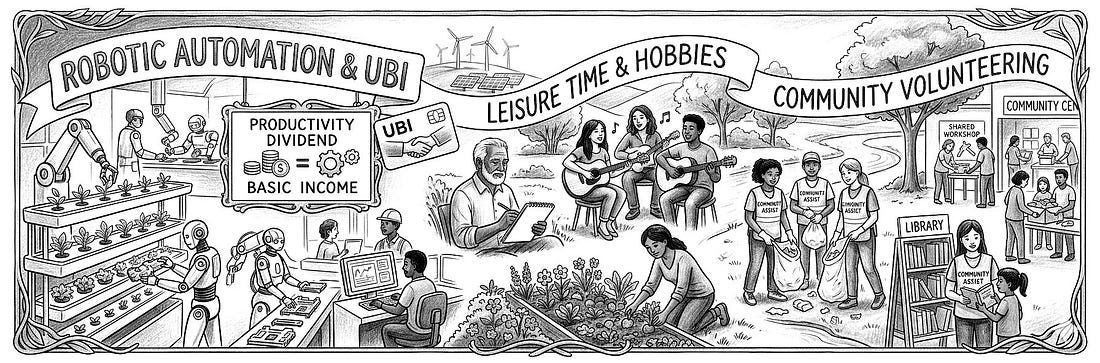
A serious proposal therefore requires a parallel investment in what we might call the infrastructure of meaning: community institutions, public service programs, apprenticeship and retraining pipelines, civic frameworks that give people useful things to do even when the formal economy no longer requires their labor in its previous form. This is not a soft add-on. It is the component that determines whether, a generation from now, we look like a country that navigated a transition well, or one that didn’t see it coming.
Alternatives Honestly Considered UBI is not the only serious policy response to automation-driven displacement, and it deserves to be measured against alternatives rather than simply against the status quo.
A federal job guarantee would offer a public-sector position to any American willing to work, eliminating involuntary unemployment by definition. It addresses the purpose problem directly and sidesteps the inflation risk of unconditional transfers. Its weaknesses are real: it requires the government to efficiently deploy potentially tens of millions of workers, a task no federal bureaucracy has performed well at scale, and it provides no floor for those who cannot work due to age, disability, or caregiving responsibilities.
Expanded wage subsidies and targeted retraining are less radical and more politically viable in the near term. They also carry a poor track record at scale. The Trade Adjustment Assistance program, designed to retrain workers displaced by trade agreements, consistently showed limited earnings recovery among participants. Retraining programs work for some workers in some circumstances; they have not demonstrated the ability to absorb economy-wide displacement.
The negative income tax, Friedman’s preferred design, accomplishes much of what a phased UBI accomplishes while preserving stronger work incentives through its phase-out structure. It is arguably the most conservative-compatible implementation of the same underlying idea, and it deserves serious legislative attention alongside the UBI framework proposed here.
UBI does not claim to be the only answer. It claims to be the most direct, administratively simple, and scalable response to a displacement problem that is coming regardless. The question is whether we build the floor before the wave, or scramble for lumber while people are drowning.
This Is Not a Left-Wing Idea Andrew Yang ran on UBI in 2020 and was dismissed as fringe. The underlying anxiety he was responding to has not diminished; it has intensified. The communities most exposed to automation-driven displacement are not urban progressive strongholds. They are the same working-class rural and exurban communities that have driven the political realignments of the last decade.
The intellectual lineage for guaranteed income runs through the right as well as the left. Friedman. Murray. Bill Gates, who proposed a robot tax to fund the social costs of automation in 2017.5 Richard Nixon, who came within a Senate vote of passing a version of the negative income tax in 1970. The idea has been on the serious policy agenda in conservative as well as progressive forms for sixty years. What has been missing is not intellectual framework. What has been missing is the political will to act before the crisis forces the decision under worse circumstances.
The pilot framework offers a viable political path. Start with geographic targeting: depressed rural counties, deindustrializing Midwestern cities, where displacement has already arrived and where the counterfactual of doing nothing is visibly failing. Measure rigorously. Scale what works. This is not a utopian leap. It is how every major American social program, from Social Security to Medicare, actually began.
The Country, First We have built the wealthiest civilization in human history. We have also built, in the process, a system that concentrates the gains of technological progress with extraordinary efficiency among those who own the technology, while distributing its disruptions broadly among those who do not.
That has always been true to some degree. What is different now is the speed, the scale, and the fact that white-collar professions that were supposed to be immune are demonstrably not. The programmer, the accountant, the paralegal, the junior analyst: the credentials that were supposed to guarantee a middle-class life, are now as exposed as the factory floor was thirty years ago.
The proposal on the table is not utopian. It is actuarial. We can see the displacement coming. We have time, right now, to design a response that preserves the dynamism and freedom that make capitalism worth defending, while building the floor that prevents its gains from being captured entirely by those who own the machines.
Complacency in the face of a structural shift this large has historically produced outcomes that no conservative would choose. We have the tools, the precedents, and if we are honest with ourselves, the resources. What remains to be seen is whether we have the wisdom to act before the crisis forces the decision for us.