The Price of Living. When the market knows you have no choice, it charges accordingly.
IKO JUN 01, 2026 June 2026 | By Iko Knyphausen | Opinion There is a principle at the foundation of every economics textbook: price is determined by supply and demand. Where competition exists, prices trend toward cost plus a reasonable margin. Where it does not, prices trend toward whatever the market will bear. American pharmaceutical pricing has become the most refined expression of that second condition in the modern world. The question worth asking is not why drug companies charge so much. The answer to that is simple: because they can. The better question is how, legally and systematically, they have arranged things so that they always can.
The Patent as a Hunting License The patent system was designed with a legitimate purpose. A pharmaceutical company invests hundreds of millions of dollars developing a new drug, running clinical trials, and navigating regulatory approval. Without a period of exclusivity, a competitor could copy the molecule on day one and undercut the original developer, eliminating any incentive to invest in the next drug. The logic is sound. The original patent term was seventeen years. The practice, as it has evolved, bears little resemblance to that original compact.
Drug manufacturers have perfected what patent attorneys call “evergreening”: the art of filing successive patents on minor reformulations, delivery mechanisms, dosages, or manufacturing processes, each one resetting or extending the exclusivity clock. A molecule that should have entered the generic market years ago remains proprietary. Competitors are kept out not by scientific innovation but by legal architecture.1 Insulin is the clearest case. Frederick Banting and Charles Best discovered insulin in 1921. Banting sold the patent to the University of Toronto for one dollar, explicitly so the drug would be available to anyone who needed it.2 For decades it was inexpensive. Then manufacturers began filing patents on analog formulations (slightly modified versions of the same molecule), claiming superior performance and securing new exclusivity periods. Between 2002 and 2013, the cost of insulin rose nearly 200 percent.3 Before the Inflation Reduction Act of 2023 capped out-of-pocket costs for Medicare patients, Americans with Type 1 diabetes were spending up to $6,000 per year on a drug whose core patent was sold for one dollar a century ago.4 The Autoinjector Premium A more recent variant of the same logic involves the delivery device rather than the drug itself. Epinephrine, the active compound in an EpiPen, is a naturally occurring hormone available as a generic injectable for a few dollars a dose. The molecule is not patented and cannot be. What Mylan patented, and then protected with a web of overlapping secondary patents, was the autoinjector mechanism: the spring-loaded pen that allows a person without medical training to administer the drug within seconds.
The device has genuine value. In anaphylaxis, speed matters and steady hands cannot be assumed. But that value does not explain the pricing. Mylan acquired EpiPen in 2007, when a two-pack retailed for roughly $100. By 2016, the same two-pack listed at over $600.5 The epinephrine dose inside costs approximately one dollar. Industry analysts estimated the manufacturing cost of the device itself at around $30.6 The markup was not driven by cost. It was driven by the fact that Mylan held over 80 percent of the epinephrine autoinjector market7 and understood, with clinical precision, that parents of children with severe food allergies are not price-sensitive shoppers. When a child’s life depends on a device, it gets purchased.
The patents Mylan used were not on scientific advances. They were on incremental refinements (a slightly different needle angle, a revised cap mechanism), stacked deliberately to prevent generic entry. When a competing autoinjector did reach the market, Mylan used exclusivity agreements with school districts as a further barrier: schools that accepted discounted EpiPens were required not to stock competing products.8 In 2022, Mylan and Pfizer settled a class action price- gouging lawsuit for a combined $609 million.9 There is a political footnote to the Mylan story that received less attention than it deserved. Heather Bresch, born Heather Renée Manchin, is the daughter of Joe Manchin, the Democratic senator from West Virginia. She joined Mylan as an intern through her father’s influence in 1992, rose to CEO in 2012, and received total compensation exceeding $113 million during her tenure.10 Mylan was among the largest career donors to Manchin’s campaigns, contributing approximately $211,000 through PACs and employees since 2009; the merged company, Viatris, became his number-one career donor overall. As the EpiPen investigation intensified in late 2016, Mylan was a principal target of the Department of Justice. When the Senate voted to confirm Jeff Sessions as Attorney General in January 2017, the Republicans already held enough votes without any Democratic support. Manchin voted for Sessions anyway, the only Senate Democrat to do so, at a moment when Sessions, as the incoming AG, would oversee the DOJ’s prosecution of the company his daughter ran.11 Manchin said publicly that he and his daughter kept their professional lives “separate.” He continued accepting campaign contributions from Mylan throughout.
Profiting from an Epidemic The EpiPen story was well publicized. Less well known, but in some ways more troubling, is what happened with naloxone during the opioid epidemic.
Naloxone is the antidote for opioid overdose. It has been available in generic form since 1985. In its standard injectable form, a vial administered intramuscularly with a syringe, it costs a few dollars a dose at wholesale.12 A Virginia company called Kaléo developed Evzio, an autoinjector version with recorded voice guidance that walks a bystander through administration. It launched in 2014 at $575 for a two-pack. High, but arguable for a device designed to function under extreme stress without medical training.
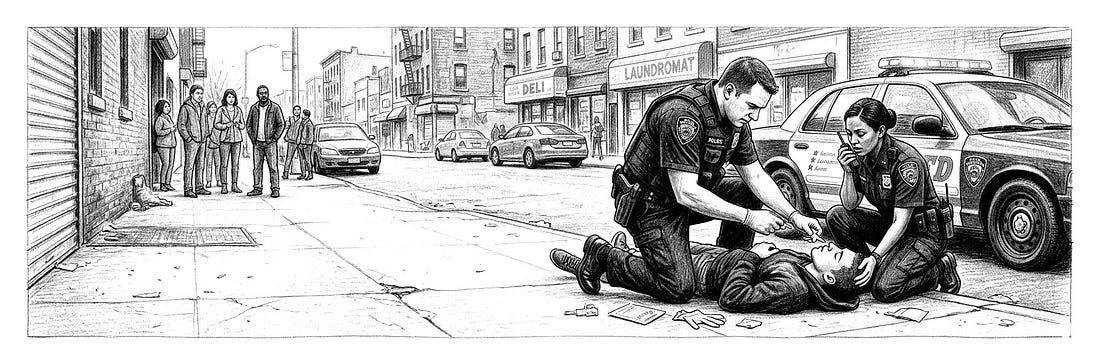
What followed was not arguable. Over the next two years, as opioid overdose deaths climbed toward 50,000 annually and Congress was actively legislating to expand naloxone access, Kaléo raised the price of Evzio more than 600 percent, to $4,100, and then higher still.13 This writer’s own prescription receipt, dated July 31, 2017, lists the retail price at $4,921.99 for a two-pack kit that also included a trainer device: an inert unit with the same recorded voice guidance but no active drug, intended for practice. The company’s own internal cost figure was approximately $174 per unit.14 Industry experts had advised pricing between $250 and $300.
Thirty-one U.S. Senators wrote to Kaléo demanding an explanation.15 The company responded that most patients received the device for free or at minimal cost through its patient assistance program. What the company did not foreground was where the money was actually coming from. The Senate investigation found that Kaléo had focused its sales force on ensuring physicians signed “medical necessity” paperwork, guaranteeing Evzio coverage by Medicare and Medicaid. The price increases resulted in more than $142 million in charges to taxpayers over four years.16 The coupons were for consumers. The bill was sent to the federal government.
This is the pharmaceutical coupon strategy in its mature form. Set a list price high enough to extract maximum revenue from institutional payers (government programs, hospital systems, insurers) who lack the individual leverage to refuse. Issue coupons to retail patients to suppress public outrage and maintain the fiction of accessibility. Donate product to first responders for goodwill and press releases. The drug flows. The money flows differently depending on who is paying.
The Acquisition Model Not all pharmaceutical price exploitation involves patents. A parallel industry has developed around the simpler strategy of acquiring the rights to an existing drug, often old, often off-patent, often with no competition, and repricing it overnight.
Martin Shkreli became the public face of this practice in 2015 when Turing Pharmaceuticals acquired the U.S. marketing rights to Daraprim, a drug used to treat toxoplasmosis in AIDS and cancer patients. The price moved from $13.50 per tablet to $750, overnight, without any change to the drug, its manufacturing, or its clinical profile.17 Daraprim had been off patent for decades. The barrier to entry was not intellectual property but the practical difficulty of navigating FDA approval for a generic of a drug with a small patient population. Turing acquired not a patent but a bottleneck.
Shkreli’s conduct made him a convenient villain, and the public reaction treated his behavior as an aberration. It was not. Questcor acquired the rights to Acthar Gel, used to treat infantile spasms and other serious conditions, in 2001 for $100,000 when the drug cost around $40 per vial. The company raised the price gradually to $1,650 over the next six years, then in August 2007 raised it overnight to $23,000. Mallinckrodt acquired Questcor in 2014 when the price had already reached $31,626, then raised it five more times, ultimately exceeding $39,000. The Federal Trade Commission charged that Questcor had also purchased the rights to Synacthen, the only potential synthetic competitor, specifically to bury it and protect its pricing monopoly. The FTC’s own statement described an “85,000 percent increase” from the drug’s 2001 price, and Mallinckrodt settled the antitrust action for $100 million.18 Valeant Pharmaceuticals raised the prices of two heart and blood pressure medications by 3,100 percent and 6,700 percent respectively between 2012 and 2015.19 These companies did not discover new drugs. They discovered that holding the only legal path to a drug that patients cannot do without is a more reliable business than science.
The Research and Development Defense The pharmaceutical industry has a standard response to all of this: drug development is expensive, risky, and failure-prone. Of every ten compounds that enter clinical trials, approximately nine fail. The companies that succeed must recover not only the cost of the successful drug but the cost of all the failures. High prices on successful drugs are the mechanism by which that risk is spread across patients.
This argument has merit as a description of genuine innovation. It has very little merit as a defense of pricing insulin at $6,000 per year when the underlying patent was relinquished in 1921, or of raising a decades- old generic antiparasitic from $13.50 to $750 overnight. The research and development defense is routinely deployed to justify pricing decisions that have nothing to do with recovering research costs. Gleevec, a leukemia drug developed by Novartis, launched at $30,000 per year in 2001. By recent years it has retailed at over $100,000.20 Research costs do not compound at that rate. Patent extensions and the absence of political will to regulate prices do.
It is also worth noting that a significant portion of foundational pharmaceutical research is publicly funded. The National Institutes of Health spends roughly $45 billion per year on biomedical research.21 Many of the most profitable drugs trace their lineage directly to NIH- funded discoveries. The public pays for the research, then pays again at the pharmacy counter at prices set by companies whose primary legal obligation is to shareholders.
There are also pharmaceutical markets (treatments for rare diseases, drugs with very small patient populations) where the economics genuinely are difficult, and where high prices partly reflect the reality of developing a drug for a few thousand patients rather than millions. These cases are real, and they deserve their own policy framework. They do not, however, explain insulin, EpiPen, Evzio, or Daraprim.
The International Exception Every other developed country regulates pharmaceutical prices. The mechanisms differ: reference pricing in Germany, negotiated formularies in France, cost-effectiveness thresholds in the United Kingdom. But the outcome is consistent. A drug that costs $500 per month in the United States typically costs $50 to $100 in peer nations.22 The drugs are identical. The manufacturers are the same. The difference is that other governments have decided that a monopoly on a life-critical product does not entitle a company to unlimited extraction.
It is fair to note that price regulation elsewhere does carry trade-offs: some studies suggest that lower regulated prices reduce manufacturer investment in certain categories of research, and that newer drugs sometimes reach patients in other countries later than in the United States. These are legitimate concerns that inform policy design. They do not justify the scale of the current American premium.
The result of that premium is that American patients effectively subsidize pharmaceutical profits for the entire world. Other countries free-ride on American pricing, which in turn is used to justify American pricing, in an arrangement that is enormously convenient for everyone except the American patient.
The Remedies the Industry Has Lobbied Against The prohibition on Medicare negotiating drug prices was written into the 2003 legislation creating the Medicare prescription drug benefit, inserted at the industry’s explicit direction after intense lobbying.23 For twenty years, the federal government, the largest drug purchaser in the world, was legally forbidden from using that purchasing power.24 The Inflation Reduction Act of 2022 partially reversed this, allowing negotiation on a limited list of high-cost drugs. The industry responded by deploying 545 lobbyist-client relationships to work against the legislation’s implementation, outnumbering reform advocates twenty to one.25 In 2025, the industry won a significant legislative carve-out through the budget reconciliation process, exempting additional drugs from negotiation eligibility.26 The pharmaceutical industry spent $388 million on federal lobbying in 2024, more than any other sector, and was on pace to exceed that in 2025.27 Three reforms would materially change the conditions described in this piece. None is radical. All have been proposed, debated, and blocked.
First, mandatory Medicare price negotiation should be extended across all drugs lacking generic competition, not limited to the short list currently eligible. The federal government purchases drugs for tens of millions of Americans. It should negotiate like it.
Second, patent evergreening should be curtailed through stricter patentability standards: secondary patents on incremental reformulations should require demonstrated therapeutic improvement over the original compound, not merely structural novelty. A new delivery mechanism does not justify a new exclusivity period unless it demonstrably improves patient outcomes.
Third, compulsory licensing authority should be codified for life-critical drugs when manufacturers price above a defined threshold relative to documented production cost. The authority exists under current law in limited circumstances; it has never been used. Making it an explicit, predictable backstop would give manufacturers a strong incentive to price within defensible bounds.
The political feasibility of all three is, at present, limited. The lobbying figures explain why.
What the Market Cannot Fix The argument for market solutions to pharmaceutical pricing runs into a simple problem: markets require the ability to walk away. A diabetic cannot walk away from insulin. A parent watching a child go into anaphylaxis cannot comparison-shop autoinjectors. A family member watching someone overdose cannot negotiate naloxone pricing with a manufacturer in Virginia.
The conditions that make market competition function (informed buyers, meaningful alternatives, the freedom to decline) do not exist for life-critical medications. What exists instead is a population of captive consumers whose necessity is, in the precise language of economics, the source of their suppliers’ pricing power. This dynamic is not incidental to the system. It is structurally reinforced by patent law, regulatory barriers, and lobbying against every proposed correction.
Frederick Banting sold his patent for a dollar because he believed a life- saving drug belonged to the people who needed it. The century since has been, in significant part, the story of how that belief was methodically reversed, and of the considerable legal, financial, and political infrastructure built to keep it that way.