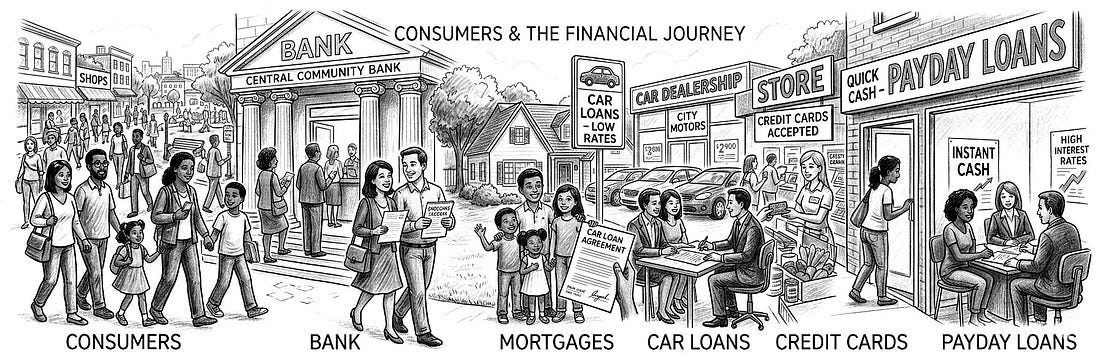
The House Always Wins. How American banking extracts wealth from the people least able to resist it.
IKO JUN 01, 2026 By Iko Knyphausen | Opinion Walk into a casino and the rules are at least clearly posted. The house edge on blackjack is around half a percent. On slot machines it runs closer to ten. The casino does not pretend to be your partner. It does not send you an annual statement describing how much it values your relationship. It does not lobby Congress to ensure that no competing venue can offer better odds.
The American financial system offers no such clarity. Its extraction mechanisms are structural, layered, and in most cases entirely legal. They are calibrated with remarkable precision to capture maximum profit from the consumers who have the fewest alternatives. The less financial sophistication you possess, the more you pay. The fewer choices you have, the higher the price. This is not an accident. It is the architecture.
The Spread Nobody Mentions Begin with the most basic transaction in consumer banking: the credit card. The Federal Reserve’s discount window, the rate at which the central bank lends to commercial banks, currently stands at 3.75 percent.1 The charge-off rate on bank credit cards, the percentage of outstanding balances that banks actually lose to default, runs at approximately 3.84 percent.2 Add those two numbers together and you have the theoretical cost basis of extending consumer credit: roughly 7.6 percent.
The average interest rate charged on American credit cards in 2025 ran between 21 and 23 percent.3 The gap between what credit costs to provide and what consumers are charged is approximately 14 to 15 percentage points. On a revolving balance of $5,000, that spread generates roughly $700 to $750 in annual profit above the cost of funds and expected losses.
There is no competitive pressure that would naturally compress this margin, because the banks largely move together. There is no meaningful regulatory cap on consumer interest rates at the federal level: the Supreme Court’s 1978 decision in Marquette National Bank v. First of Omaha Service Corp. established that a bank can export the usury laws of its home state nationwide.4 South Dakota and Delaware promptly eliminated their usury caps. Every major card issuer relocated their credit operations there. The result is that there is, functionally, no cap on what a bank can charge an American credit card holder.
The people most affected by this are not wealthy. The consumers who carry revolving balances, month after month, at 22 percent interest are disproportionately lower-income households who lack access to alternatives: no home equity to borrow against, no investment account to draw down, no family wealth to serve as a buffer. They are, in the language of finance, “credit constrained.” They are also, in the language of banking, the most profitable customers on the book.
Payday Lending: Risk as Pretext If the credit card spread represents extraction at the margins, payday lending represents it at the center. The payday loan is the financial industry’s most honest product in one respect: it makes no pretense of serving the borrower’s long-term interests. It is structured to perpetuate itself.
The mechanics are simple. A borrower in need of $375 before their next paycheck walks into a payday lender and pays a fee of $15 to $20 per $100 borrowed, typically due in full within two weeks. That fee, annualized, translates to an APR of 391 percent on the low end.5 In states without caps, it routinely exceeds 500 or 600 percent. The highest state average, Idaho, runs at 652 percent APR.6 The industry defends these rates on the grounds of default risk. The loans are short-term and unsecured; many borrowers are financially distressed; losses are high. This is partially true. The CFPB found that for rent-a-bank payday installment loans, charge-off rates average 50 to 55 percent of loan portfolios, more than twenty-five times the charge-off rate for conventional bank credit cards.7 But the arithmetic does not hold up as a justification for 391 percent. If 55 percent of loans default and the lender recovers nothing on those loans, pricing the product at the actual cost of risk would require roughly 60 to 80 percent APR, not 391 percent. The remainder is not risk compensation. It is margin. And the CFPB found that four out of five payday loans are either rolled over or renewed within fourteen days, meaning that for most borrowers the two-week loan becomes a multi- month obligation.8 The Pew Charitable Trusts found that the average borrower takes five months and multiple rollovers to repay a $375 loan, ultimately paying approximately $520 in fees to borrow that amount.9 The population using these products is not choosing them from a menu of attractive alternatives. Approximately 12 million Americans use payday loans each year. They are, almost by definition, people who cannot access bank credit, cannot tap home equity, and cannot absorb an unexpected expense from savings. The payday lender is often the only credit window available. That captivity is what makes the pricing possible, and what makes the moral case for the rates so thin.
The IPO Queue Rotate now to a different kind of extraction, one that operates not on the financially desperate but on anyone who has ever read about an eagerly anticipated stock offering and assumed they could participate.
When a company goes public through an initial public offering, its investment bank underwrites the deal and sets an offering price. The shares are then allocated before public trading begins. The split between institutional and retail investors is, historically, approximately 90 percent institutional and 10 percent retail.10 Hedge funds, mutual funds, pension managers, and private wealth clients at the underwriting firm get in at the offering price. The retail investor gets in when the market opens.
Research by Jay Ritter at the University of Florida, covering IPOs from 1980 through 2022, found that the average first-day return is 18.4 percent.11 That gain, on average, is captured by the institutions allocated shares at the offering price. The retail investor buys into the second-day market after the surge has already occurred, frequently at or above the post-pop price, and often into a long period of underperformance: the same dataset shows an average three-year market-adjusted return of negative 20.2 percent for IPO buyers.12 The DoorDash IPO in December 2020 is a clean illustration. The offering price was $102. When trading opened, the stock was at $182, a first- day gain of 78 percent. Institutional buyers at the offering price captured that gain; retail buyers who entered at $182 did not. They were not late because they were slow. They were late because the system allocated early access to institutional clients as a matter of policy, and their later arrival was structurally guaranteed.
This arrangement persists because it is profitable for the underwriting banks, which use IPO allocations as relationship currency with institutional clients. It persists because retail investors lack the standing, leverage, or organization to demand otherwise. And it is set to repeat at scale: the anticipated IPOs of Anthropic and SpaceX, expected later in 2026, will almost certainly follow the same template. The most sought- after allocations will go to institutions; the retail public will be invited to buy after the opening pop. Whether those openings deliver substantial first-day returns remains to be seen. That retail investors will be structurally last in line does not.
The Car Loan: Two Markups for the Price of One For most Americans outside dense urban centers, a car is not a discretionary purchase. It is how you get to work, to the doctor, to the school, to the grocery store. The inability to walk away from a necessity is, as this piece has argued elsewhere, the precondition for extraction. Auto lending has refined that precondition into an art form with a hidden second layer that most borrowers never detect.
The first layer is familiar: credit-tier pricing. According to Experian’s most recent data, a borrower with a super-prime credit score (781 to 850) paid an average APR of 4.66 percent on a new car loan in Q4 2025. A borrower in the deep subprime tier (below 500) paid 16.01 percent on the same new car, and 21.58 percent on a used one.13 That is an eleven-point spread on new cars attributable entirely to credit tier. On a $30,000 loan over sixty months, the difference between a 4.66 percent rate and a 16 percent rate is approximately $9,000 in additional interest paid over the life of the loan.
The second layer is less visible. When a buyer finances a car through a dealership, the dealer does not simply connect the buyer with a lender. The lender quotes the dealer a “buy rate,” the actual interest rate the lender will accept based on the borrower’s credit profile. The dealer is then free to mark that rate up, typically by one to two and a half percentage points, and pocket the difference. The buyer is told only the final rate and is legally not required to be shown the buy rate from which it was derived. The dealer presents the marked-up rate as simply the rate the borrower qualified for.14 The Center for Responsible Lending estimated that this undisclosed markup costs American car buyers $25.8 billion in excess interest over the lives of their loans, a figure that exists entirely because buyers cannot see the price floor from which they are being marked up.
The CFPB identified an additional dimension: the markup is not applied equally. Statistical analysis of large auto lender portfolios found that minority borrowers were charged higher dealer markups than white borrowers with equivalent credit profiles. Toyota Motor Credit, Honda Financial, Ally Financial, and Fifth Third Bank all paid nine-figure settlements to the CFPB and the Department of Justice for discriminatory dealer markup practices.15 In each case the lender was held responsible for a markup it did not set but had authorized dealerships to apply with discretion.
The scale of the market makes this more than a marginal concern. Total outstanding auto loan and lease debt in the United States reached $1.67 trillion in Q4 2025.16 Subprime delinquency rates hit 6.6 percent in January 2025, the highest on record since tracking began in 1994.17 More than 1.73 million vehicles were repossessed in 2024, the highest number since the recession year of 2009. These are not abstract statistics. They represent households that needed a vehicle to function, accepted terms they could not sustain, and lost the transportation that connected them to employment.
The car loan is the payday loan in a suit. The amounts are larger, the terms longer, and the collateral is the borrower’s ability to get to work. The fundamental mechanism is identical: a captive buyer, a tiered pricing structure calibrated to extract the maximum the borrower will accept, and a disclosure framework designed to ensure the buyer cannot easily determine whether they are being charged fairly.
Your Credit Score Is a Pricing Mechanism The FICO score was introduced in 1989 as a standardized measure of credit risk. It ranges from 300 to 850. It is, by any reasonable measure, a useful instrument: it correlates meaningfully with default probability and allows lenders to price risk more precisely than anecdotal underwriting. None of this is disputed. What is disputed, or at least insufficiently examined, is whether the rate premiums charged to lower- score borrowers are calibrated to actual risk, or whether they exceed it systematically.
The Federal Housing Finance Agency studied 200 million mortgages issued between 1990 and 2019, estimating what each loan’s default probability would have been if originated during the 2008 financial crisis. Subprime borrowers, defined as those with FICO scores below 660, had a stressed default rate largely in sync with borrowers carrying higher scores.18 The implied risk premium built into subprime mortgage rates was not supported by the actual loss experience when conditions became universally stressed. The risk, in other words, was real but overstated, and the overpayment was not incidental.
A September 2025 Federal Reserve analysis of 1.25 million mortgage loans confirmed the pattern: interest rate spreads for lower-FICO borrowers exceed what default models predict at origination.19 An academic study found a further mechanism: low-FICO borrowers pay more not only because of risk-based pricing, but because they search and negotiate less effectively, and lenders exploit that information asymmetry.20 Now consider who occupies the low end of the FICO distribution. The Federal Reserve Bank of New York found that low-income families have a median credit score of 658, moderate-income families 692, middle- income families 735, and high-income families 774.21 By race, Black Americans carry an average FICO score of 677; Asian Americans average 745.22 The FICO distribution is not a neutral sorting of financial behavior. It maps, with uncomfortable precision, onto the existing structure of income and wealth inequality.
And the distribution is bifurcating. FICO’s own data, released in March 2026, showed the middle score range of 600 to 749 shrinking from 38.1 percent of the population in 2021 to 33.8 percent in 2025, while more consumers moved into both the highest and lowest brackets.23 The K- shaped economic recovery, well documented in income and wealth data, is now visible in the credit score distribution. The people moving up the distribution pay lower rates on better terms. The people moving down pay higher rates on worse terms, and have fewer places to go.
The Deposit Silence There is a version of this story that requires no study of credit scores, no analysis of payday lending mechanics, no knowledge of IPO allocation conventions. It requires only a bank statement.
In March 2022, the Federal Reserve began raising the federal funds rate for the first time since 2018, ultimately lifting it by more than five percentage points over the following eighteen months. Banks responded immediately on the lending side. JPMorgan Chase was charging 6.98 percent for mortgages and 18 to 27 percent for credit cards within months of the first rate increase. On the deposit side, the response was different. Chase continued paying 0.01 percent on demand deposit accounts: effectively zero.24 Senators Reed and Warren wrote to Jamie Dimon in January 2025 noting that two years after the rate-hiking cycle, despite record profitability, Chase had still not passed meaningful rate increases to depositors.25 The bank earned $58.5 billion in net income in 2024. The national banking industry’s average net interest margin reached 3.39 percent in Q4 2025, the highest since 2019.26 The depositor paying attention can compare the savings account rate at 0.01 percent to the 4 to 5 percent available from a Treasury money market fund or a high-yield online bank. Many depositors, particularly older and less financially sophisticated ones, do not make that comparison. They leave the money where it has always been, in the same institution that now lends it out at 7 percent and charges them 22 percent if they need it back quickly. The asymmetry is not accidental. It depends on inertia, trust, and the friction of switching.
Capital One provides a recent regulatory illustration of how far this practice extends. In its final week in office, the CFPB filed suit alleging that Capital One had systematically steered customers away from its own higher-yield savings products, costing them more than $2 billion in interest they were never told they could earn.27 This was not a case of a bank failing to advertise a good rate. It was a case of a bank designing its customer experience to keep money earning next to nothing, in accounts where the spread between cost to the bank and return to the customer was, essentially, the entire interest rate.
The Enforcement Record One could present each of the foregoing practices as an isolated feature of a complex industry. The regulatory record suggests otherwise. The pattern of enforcement actions over the past decade documents not isolated failures but systemic, recurring conduct across the largest institutions in the country.
Wells Fargo became the first bank in American history to receive a second asset growth cap from a federal regulator, in addition to its ongoing 2018 cap, when its compliance failures continued through 2024. The CFPB has ordered Wells Fargo to pay more than $3.7 billion in redress and penalties across a series of actions, the largest total fine the agency has ever imposed on a single institution, covering illegal fees, wrongful repossessions, improper mortgage charges, and overdraft abuses.28 Bank of America was ordered in 2023 to pay more than $100 million to customers for systematically double-charging nonsufficient funds fees on the same transaction, withholding credit card rewards explicitly promised to customers, and opening accounts without customer authorization, practices that echoed the Wells Fargo fake account scandal of 2016.29 JPMorgan paid $151 million in October 2024 to settle five SEC enforcement actions covering misleading disclosures to investors, breach of fiduciary duty, prohibited transactions, and failure to make recommendations in customers’ best interest.30 TD Bank became, in 2024, the first bank in United States history to plead guilty to conspiracy to launder money, in connection with a Department of Justice investigation that found the bank had systematically ignored money-laundering warning signs. The OCC imposed an asset growth cap on TD’s American operations indefinitely.31 Goldman Sachs paid $65 million for deficiencies in the Apple Card rollout. Navy Federal Credit Union paid $95 million for illegally charging overdraft fees.32 None of these actions resulted in individual criminal accountability for senior executives. All were treated, in the language of the institutions involved, as matters resolved without admission of wrongdoing. The fines, in most cases, were substantially smaller than the profits generated by the conduct they addressed. The pattern that emerges is not one of occasional failure corrected by vigilant oversight. It is one of persistent extraction, intermittently fined, then resumed.
The Remedies and Their Opponents None of the conditions described here are natural laws. They are policy choices that could be altered by different policy choices.
A federal usury cap on consumer interest rates would directly compress the credit card spread. A cap at 36 percent APR, the threshold used by the Military Lending Act for active-duty service members, would not eliminate credit card lending: it would eliminate the most predatory tier of it.33 Payday loan APR caps have been enacted in a growing number of states with no collapse of consumer credit access: Ohio moved from a 677 percent average APR to 138 percent after its 2019 reform, with the market continuing to function.34 Reform of the IPO allocation system has been discussed for decades and implemented nowhere. The SEC has the authority to require more equitable retail access; it has not used it. Direct listing mechanisms, which allow shares to begin trading without a formal book-building process that privileges institutional clients, have been used by a small number of companies. They remain the exception.
On mortgages, the alternative credit assessment models that might reduce the punitive impact of FICO’s risk-pricing on lower-income borrowers have been persistently resisted by the large institutions that benefit from the current system. The Federal Housing Finance Agency has pushed to broaden credit score eligibility; implementation has been slow.
Mandatory disclosure of the buy rate on dealer-arranged auto financing would cost the industry nothing except the margin it currently extracts in secret. A 2013 CFPB survey found that 93 percent of consumers favored requiring dealers to disclose the lowest interest rate for which the borrower qualified. The rule has not been written.
On deposits, the CFPB’s action against Capital One is the first significant enforcement measure addressing the systematic withholding of interest from savers. Whether it changes industry practice or becomes a one- time settlement depends on whether the agency retains the political will and independence to pursue it.
The lobbying numbers are instructive. The financial services industry spent approximately $700 million on federal lobbying in 2023, more than any other sector including pharmaceuticals.35 Every reform listed above has a well-funded, professionally organized opponent.
The Geometry of Captivity There is a thread connecting each of these practices: each one extracts most efficiently from the person who has the least capacity to resist or escape.
The credit card spread falls heaviest on the revolving borrower who cannot pay the full balance and has no cheaper alternative. The payday borrower has no bank credit. The retail IPO investor cannot access the institutional book. The car buyer in a subprime tier pays an eleven-point rate premium and a hidden dealer markup on a vehicle they cannot function without. The low-FICO mortgage borrower cannot shop as effectively and has fewer options. The inert depositor does not know, or cannot easily act on the knowledge, that their savings are earning a fraction of the available rate.
The FICO distribution makes this geometry visible. Half of American consumers now score above 750; that share has grown. A widening lower tail, disproportionately lower-income, disproportionately minority, is paying premium rates on the premise of elevated risk that the FHFA’s own analysis found to be overstated. The K-shaped recovery in credit scores mirrors the K-shaped recovery in incomes and wealth. The divergence is not coincidental. The credit system both reflects and reinforces it.
There is an argument, made in good faith by some economists, that risk-based pricing democratizes credit access: without the ability to charge more to riskier borrowers, lenders would stop lending to them altogether. This is partially true and regularly overstated. The record of countries with rate caps shows functional consumer credit markets operating at substantially lower margins. The record of American enforcement actions shows institutions that do not primarily compete on price, but on access to captive customers.
The casino, at least, posts its odds.