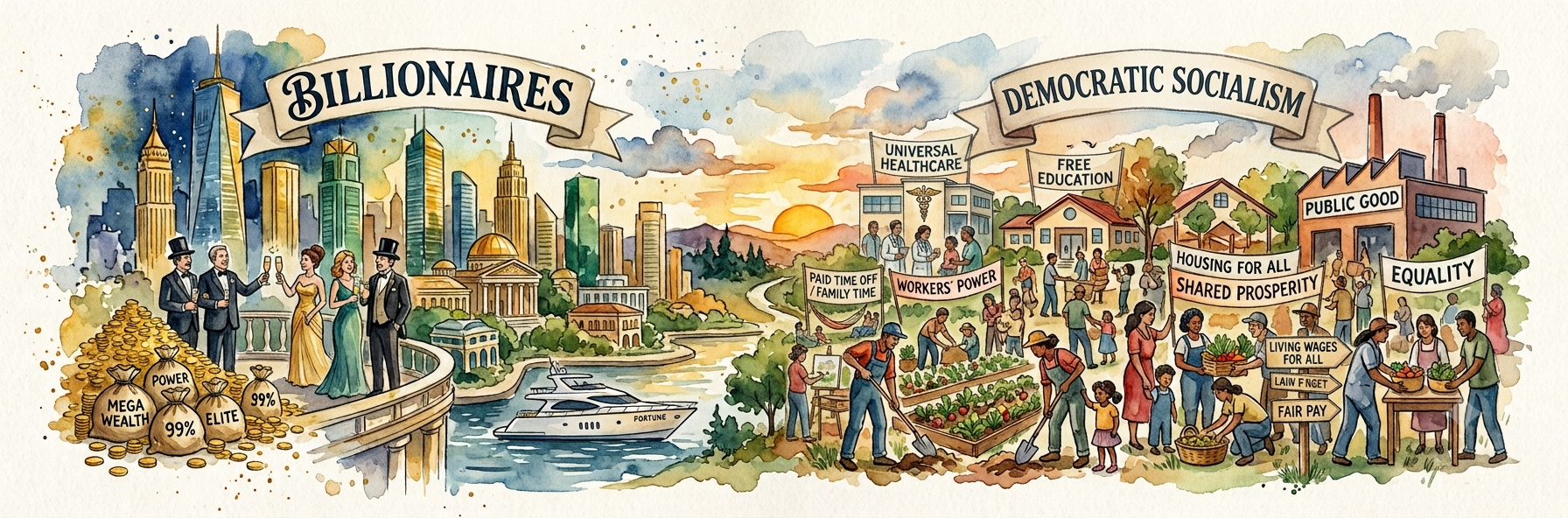
No country has produced more billionaires than America. No wealthy democracy is more allergic to the word socialism. The two facts are connected, and seeing how requires being precise about a word that gets thrown around carelessly by everyone in this debate.
Norway struck oil in the North Sea in 1969, the same story America had already been living offshore for decades. Today Norway's sovereign wealth fund holds more than $2.2 trillion, roughly $390,000 per citizen, the largest such fund on earth.1 America has no equivalent. The difference was never geology. Norway decided the oil beneath its seabed belonged to the Norwegian people and built accordingly. The United States left subsurface rights fragmented among private landowners, states, and the federal government, a patchwork that rewarded extraction over accumulation. That is how a small number of families became "Rockefellers". In America, that distinction, between owning common wealth and merely extracting it, is exactly the kind of argument that gets buried the moment anyone brings it up. One powerful phrase instantly kills the conversation: “That’s socialism”.
Norway is not a socialist country. It is a capitalist democracy that made a different structural choice, and its citizens are the ones who benefited.
Bernie Sanders calls himself a democratic socialist and points to Scandinavia as his model, and his critics are right to push back on the label. Socialism, properly defined, means the state or the collective owns the means of production, and what Denmark, Sweden, Norway, and Germany actually run is market capitalism with a heavy dose of social guardrails and redistribution, a system more precisely called social democracy. Their own center-right parties govern within that framework without renationalizing anything. That much is a fair correction, and it is worth taking seriously rather than dismissing as right-wing spin.
But the correction cuts both ways, and it is worth being honest about the other half. The Democratic Socialists of America, the organization actually driving the American movement that carries the socialist label, says plainly that it wants to go further than the European model: public or cooperative ownership of energy, transit, and other "key economic drivers," not simply taxation and benefits layered on top of private ownership.2 Sanders-style admiration for Nordic welfare states and the DSA's actual platform are not the same thing, even though the same word gets applied to both, and collapsing them serves no one. It lets critics dismiss a modest, already-tested policy platform as a dangerous fantasy, and it lets the more ambitious version borrow credibility it has not earned from Denmark's actual economic arrangement. What follows is a case for the modest version: a stronger social contract inside a market economy, not a different economic system.
What would that contract look like? Something close to what the Nordic countries already provide: five or six weeks of paid vacation as a norm, parental leave measured in months rather than weeks, universal healthcare with copays that do not bankrupt anyone, affordable university, wages people can live on, pensions that hold. None of that requires abolishing private property or nationalizing industry. It requires deciding that a productive economy should sustain the people who run it, not merely enrich the people who own it.
America has chosen differently, and the numbers show it. By September 2025, the United States had 905 billionaires holding a combined $7.8 trillion, up from 813 billionaires and $6.72 trillion at the close of 2024.3 The Federal Reserve's Survey of Consumer Finances puts the top 1 percent's share of household wealth at roughly 31 percent, up from 23 percent in 1989, while the bottom half of the country holds just 2.8 percent.4 That concentration did not happen by accident: 100 billionaire families spent $2.6 billion, 16.5 percent of all political contributions, in the 2024 election cycle, up from $18 million in 2000.5
On the other side of the ledger, roughly two-thirds of American personal bankruptcies have a medical cause as a contributing factor, a share with no equivalent in any country with universal coverage, and nearly one in five adults carrying healthcare debt has lost a home or filed for bankruptcy because of it.67 Total student loan debt exceeds $1.77 trillion across more than 42 million borrowers, averaging roughly $38,000 each, while the Pell Grant, the main federal aid program for low-income students, now covers only about 31 percent of public university costs, less than half what it covered a generation ago.89 The richest country in human history is the only wealthy democracy where a cancer diagnosis or a college acceptance letter can become a life sentence of debt.
There is also a favored American answer to gaps like these: philanthropy instead of policy. That generosity is real and it does real good, but there is a moral difference between a right and a gift. A billionaire who funds a hospital wing decides who benefits and on what terms; a citizen who receives healthcare as an entitlement is a participant in something that belongs to everyone equally. A country that relies on private largesse to perform government's basic functions has not transcended inequality. It has institutionalized it, and handed the results to people who answer to no electorate.
The gap shows up inside companies too. The average CEO-to-worker pay ratio across the S&P 500 hit 285-to-1 in 2024, up from 21-to-1 in 1965; at the 100 companies with the lowest median worker pay, it reached 632-to-1.10 Starbucks set the record that year: its CEO collected $95.8 million while the median employee earned $35,000 to $46,000 - $17 / hour plus tips, part-time adjusted to full-time - , a ratio of 2,300-to-1.11 Adjusted for inflation, CEO pay at large firms rose 1,209 percent between 1978 and 2022, while a typical worker's pay rose 15.3 percent.12 There is a case that transformative executives create value that justifies exceptional pay, and that case deserves a hearing. But it rests on an accounting that ignores the one resource every human being holds in exactly equal measure: time. The refinery worker and the CEO both trade hours of a finite life for a paycheck. Only one of them is routinely trading years off the end of it.
None of this is an argument that the economy is zero-sum. It is not. A productive, growing economy generates a real surplus, and a well-managed one can distribute that surplus broadly without anyone losing their shirt. The Nordic countries prove this daily: high taxes, high growth, high living standards, all at once. The problem is not productivity. The problem is what gets done with the surplus productivity creates.
Reckless spending can erase that surplus faster than growth can rebuild it, and nothing in the federal budget demonstrates that better than the Pentagon. Between its base budget and reconciliation funding, total defense spending is on track to top $1 trillion for the coming fiscal year, more than the next several countries combined, even as the foreign aid infrastructure that bought goodwill at a fraction of the cost of any weapons platform gets dismantled.13 From an individual’s vantage point, a trillion dollars a year is not an abstract number; it is the difference between a paycheck that covers a hospital bill and one that does not.
Universal healthcare is not a fantasy line item. It is arithmetic. Spend less on the military and the money exists. Reduce the national debt and the country stops paying interest on money it has already spent, freeing up more of the same. The United States does not have a resource problem; it has an allocation problem. Norway didn't have more wealth to work with; it chose to bank its oil revenue in a sovereign fund and cap annual withdrawals at a fixed 3 percent of the fund's value. Spending now accounts for roughly a fifth of the government's budget. America makes a different choice every year, when it funds a trillion-dollar defense budget instead of universal healthcare or debt reduction. Universal coverage, a restored Pell Grant, a sovereign wealth fund seeded by public mineral royalties: none of it requires abolishing markets or nationalizing industry. It requires the same thing Norway required. Fiscal discipline.
That is also, worth noting, a lower bar than what the actual democratic socialist movement is organizing for. Whatever one thinks of collective ownership of energy and transit, or a Medicare for All system that eliminates private insurance outright rather than competing alongside it, those are bigger asks than the ones made here, and they deserve to be argued on their own terms rather than smuggled in under a euphemism, or dismissed as a euphemism when they are not one. Precision cuts in every direction. It just rarely gets applied evenly.
George Carlin put the arrangement more bluntly than any policy paper could. He described a country where the upper class keeps all the money and pays none of the taxes, the middle class does all the work and pays all of the taxes, and the poor exist mainly to scare the middle class straight, to "keep 'em showing up at those jobs."
That is the description of a system operating exactly as designed.
Can America afford a Nordic-style social contract? Denmark, Norway, and Sweden settled that question decades ago, and their center-right parties have governed within it without repeal. Will democratic socialism destroy the economy, as critics suggest, or just the obscenity of extreme wealth, as its proponents believe? The challenge is whether we can use the word socialism precisely enough, critics and advocates alike, for Americans to actually weigh that contract on its merits.