Norway struck oil in the North Sea in 1969. So did the United States, which had been drilling offshore for decades before that. Today, Norway’s sovereign wealth fund stands at more than $2.2 trillion, equal to roughly $390,000 for every Norwegian citizen, making it the largest sovereign wealth fund in the world by total assets under management.1 America’s comparable fund does not exist. The difference is not geology, and it is not simple. Norway also had the political will, the institutional design, and the timing to capture its windfall before private interests could entrench. But none of those factors could have operated without the foundational choice that preceded them: Norway decided that oil beneath the seabed belonged to the Norwegian people, and built from there. The United States made a different choice, and its citizens received nothing from the common ground beneath them.
In most of the world, subsurface mineral rights belong to the state, meaning to the people. In the United States, those rights are fragmented across private landowners, state governments, and federal land, a patchwork that has historically favored private extraction over public accumulation. That is how you become a Rockefeller. It is a foundational expression of American belief in private property, and it has made a small number of individuals extraordinarily wealthy. It has not built a multi-trillion-dollar fund for the common good. Norway is not a socialist country. It is a capitalist democracy that made a different choice, and its citizens are the beneficiaries.
This distinction matters enormously, because in America today any conversation about economic fairness is immediately and deliberately derailed by a single word: socialism. The word is deployed as a weapon, and it works, in part because its targets have handed their opponents the ammunition. Bernie Sanders, who has spent a career admiring the social democracies of Scandinavia, calls himself a socialist. But socialism, properly defined, is an economic system in which the state owns the means of production. What Sanders admires, and what Norway, Denmark, Germany, and Sweden actually practice, is capitalism with social guardrails, a distinction those countries’ own center-right parties accept and govern within. The confusion is not semantic hair- splitting. It is the difference between a genuine policy debate and a Cold War ghost story. By choosing the wrong word, a generation of reformers has spent its energy debating a strawman of its opponents’ construction.
What do those social guardrails actually look like? Thirty days of paid vacation per year as a norm. Parental leave of up to two years, with a guaranteed job upon return. Universal healthcare with copays that do not bankrupt families. Free university education. Living wages. Pensions. These are not the fruits of socialism. They are the fruits of a social contract, an agreement that a productive economy should sustain the people who make it run, not merely enrich those who own it.
The Billionaire Ledger The United States has no such contract. What it has instead is the most billionaires on earth, and some of the most crushing poverty, homelessness, and preventable illness in the developed world. Aristotle distinguished between two kinds of economic activity: oikonomia, the management of resources in service of a good life, and chrematistics, the accumulation of wealth as an end in itself. He considered the latter a kind of moral disorder, a confusion of means for ends. At the close of 2024, there were 813 billionaires in the United States with a combined total wealth of $6.72 trillion, according to an Institute for Policy Studies analysis of Forbes data.2 By September 2025, that number had risen to 905 billionaires holding a combined $7.8 trillion.3 The Federal Reserve’s Survey of Consumer Finances finds that the top 1 percent of households control roughly 31 percent of all American wealth, up from 23 percent in 1989, while the bottom 50 percent share just 2.8 percent of the nation’s total net worth.4 That narrowing has not happened by accident. According to Americans for Tax Fairness, 100 billionaire families spent $2.6 billion (16.5 percent of all political contributions) in the 2024 election cycle, up from a mere $18 million in 2000.5 The Medical and Education Debt On the other side of that ledger, the picture is stark. A study published in the American Journal of Public Health estimated that roughly 66.5 percent of personal bankruptcies in the United States have a medical cause as a contributing factor, a share that dwarfs comparable figures in countries with universal coverage.6 Nearly one in five adults with healthcare debt has either declared bankruptcy or lost a home because of it.7 The richest country in human history is the only wealthy democracy where a cancer diagnosis can become a financial death sentence.
Take Maria Gonzalez, a registered nurse in Houston, not a hypothetical but a representative of thousands whose stories appear in CFPB complaint data and medical debt research. She earns $58,000 a year, carries $34,000 in student loan debt from a two-year nursing program, and, after a hospitalization in 2023, added $19,000 in medical bills she cannot discharge. She is, by most measures, a success story of the American system: skilled, employed, essential. She is also one missed paycheck from a credit event that will follow her for a decade.
Higher education compounds the injury. Total outstanding student loan debt in the United States now exceeds $1.77 trillion, owed by more than 42 million borrowers, with an average balance of roughly $38,000 per person.8 This is not a tax on ignorance. It is a tax on ambition, extracted primarily from the young, from the first-generation student reaching for upward mobility that American capitalism has always claimed to champion. The Federal Pell Grant, the primary federal aid program for low-income students, covered only about 31 percent of public university costs in 2024, less than half what it covered in earlier decades.9 The ladder remains standing; the rungs have simply been priced out of reach.
The Right and the Gift When the gaps created by this absence of a social contract become unbearable, the American response is often not policy. It is philanthropy. Americans are among the most generous people on earth, and that generosity deserves genuine respect. Some philanthropic endeavors have seeded real public goods: the Gates Foundation’s vaccine partnerships have saved millions of lives; local community foundations have built infrastructure that governments failed to fund. Charitable giving in the United States runs into the hundreds of billions of dollars annually.
But there is a profound moral difference between a right and a gift. When a billionaire funds a hospital wing or endows a university scholarship, the donor decides who benefits and on what terms. When a citizen receives healthcare or education as a matter of civic entitlement, they are a participant in a shared project that belongs to everyone equally. Philanthropy is also selective in ways that government programs, at their best, are not: it tends to flow toward causes that flatter the donor, toward institutions that serve the already-fortunate, and away from the unglamorous needs of the very poor. A society that relies on private largesse to perform the basic functions of government has not transcended inequality. It has institutionalized it, and placed the well-being of its citizens in the hands of people who answer to no electorate.
The CEO and the Janitor That smallness is worth sitting with for a moment. The average CEO-to- worker pay ratio across S&P 500 companies stood at 285-to-1 in 2024, with average CEO compensation reaching $18.9 million.10 In 1965, that ratio was 21-to-1.11 At the 100 S&P 500 corporations with the lowest median worker pay, the ratio had widened to 632-to-1 by 2024, with CEOs averaging $17.2 million while median workers earned $35,570.12 Starbucks set a record: its CEO collected $95.8 million in 2024 while the median employee earned $14,674, a ratio of 6,666-to-1.13 Adjusted for inflation, CEO compensation at large firms increased by 878 percent between 1978 and 2022, while real worker compensation rose by 4.5 percent.14 There is a case to be made that an executive who engineers a transformative merger, secures a landmark government contract, or navigates a company through crisis creates value that justifies exceptional compensation. That case deserves to be heard. But it rests on an accounting of value that measures only money generated and ignores a resource that every human being shares in exactly equal measure: time. The janitor and the CEO both arrive at work trading hours of their one finite life. The refinery worker breathing hazardous air may be trading years of it, surrendering a measurable fraction of an 80- year allotment without any premium for the sacrifice. That sacrifice is invisible to the spreadsheet. A more honest capitalism might tie executive compensation to a meaningful multiple of the lowest wage in the organization; not to eliminate reward for excellence, but to acknowledge that excellence is never built alone.
The Same Fact from Opposite Ends The structural question of who owns national resources sits beneath all of this. Norway’s answer to that question produced $2.2 trillion for the common good. The American answer has produced more absolute billionaire wealth than any country on earth and a government that cannot guarantee its citizens access to a doctor. These are not unrelated facts. They are the same fact, seen from opposite ends.
There are things that could be done. A federal sovereign wealth fund, seeded by new royalty regimes on offshore drilling and federal mineral leases, would not require confiscating private property: it would simply ensure that publicly owned resources generate public returns. Stronger disclosure requirements for political spending, already enacted in several states without legal challenge, would make the donor class visible. Restoring the Pell Grant to its historic share of public university costs would rebuild a ladder that policy dismantled. None of these proposals is utopian; versions of each have been implemented somewhere in the democratic world.
The United States spends more than $1 trillion annually on defense, more than the next several adversaries combined, while simultaneously dismantling the foreign aid infrastructure, including USAID, that purchased global goodwill at a fraction of the cost of any weapons system. The calculus of what that trillion could accomplish domestically is not a radical thought experiment. It is an arithmetic one. And the political system that makes reallocation nearly impossible, is not incidental to the inequality described here. That system is built around two parties whose primary function is to protect the interests of their largest donors. It is the mechanism.
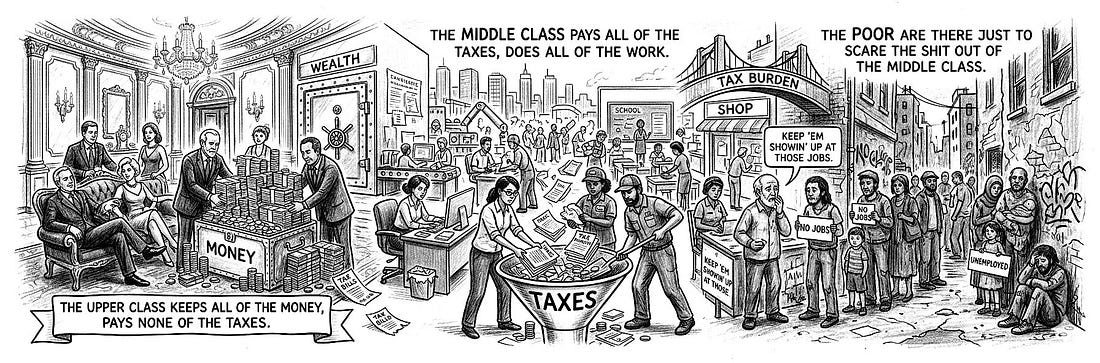
George Carlin, who had a gift for compressing structural critique into something that lands like a fist, put the whole arrangement plainly: “The upper class keeps all of the money, pays none of the taxes. The middle class pays all of the taxes, does all of the work. The poor are there just to scare the shit out of the middle class. Keep ‘em showing up at those jobs.”
That is not a punchline. It is a description of a system working exactly as designed.
The question is whether Americans will ever be permitted to have an honest conversation about redesigning it, or whether the word socialism will keep doing its job.