In June 1971, President Richard Nixon stood before Congress, declared drugs “public enemy number one,” and committed $100 million to launch what would become the longest domestic policy campaign in American history. The goal was nothing short of total victory: eradicate the drug menace, make it scarce, make it expensive, make it gone. More than half a century and over a trillion dollars later, the drugs are still here. The cartels are still here. In 2024, roughly 80,000 Americans died from accidental overdose1, eclipsing the entire American death toll of the Vietnam War by more than twenty thousand lives. The war on drugs has not failed because we fought it poorly. It has failed because it was designed around a premise that was always false: that you can arrest your way out of demand.
The Cartel Always Wins The record is consistent enough to read as law. Take down a cartel boss, and a successor emerges within months, often more violent and more adaptive than the one before. Shut down a distribution network, and a new one materializes along a different corridor. Flood the streets with officers, and the market migrates to encrypted apps and dark web storefronts. This pattern has been documented repeatedly, from the collapse of the Medellin Cartel in the early 1990s, which simply transferred dominance to the Cali Cartel, to the post-El Chapo fragmentation of Sinaloa into factions more numerous and harder to track than before. Each tactical success leaves the underlying market intact. The cartel always wins.2 The explanation is structural. Any prohibition imposed on a commodity for which robust demand exists will produce the same result. Economics does not pause for moral conviction. When a product is criminalized, its price rises to incorporate what economists call the “risk premium”: the markup that compensates suppliers for the probability of arrest, seizure, and violence. That premium does not discourage supply. It selects for it. The people willing to operate in that environment are precisely those least deterred by the risks involved, and the profits on offer are sufficient to guarantee a steady queue of willing participants. When one is removed, the queue advances.
The historical precedent is plain. Between 1920 and 1933, the United States conducted a real-world experiment in prohibiting a legal intoxicant consumed by tens of millions of Americans. Alcohol consumption went underground. Supply chains reorganized under the management of organized crime. Figures like Al Capone built industrial- scale enterprises precisely because the prohibition environment was so commercially rewarding. When Prohibition ended, so did Capone’s business model. The lesson was available. It was not learned.
Today, fentanyl, heroin, methamphetamine, and cocaine operate under the same economic logic that once made bootlegging profitable. The cartels operating out of Sinaloa, Jalisco, and the Sonoran corridor are the system working exactly as prohibition economics predicts. In February 2026, Mexican authorities announced the death of Nemesio Oseguera Cervantes, known as El Mencho, leader of the Jalisco New Generation Cartel, one of the largest fentanyl traffickers to the United States.2 Violence erupted across Jalisco within hours as factions competed to fill the vacuum. The war on drugs had scored a tactical victory. The war on drugs had changed nothing.
One further complication deserves honest acknowledgment: the current overdose crisis has its roots in physicians’ offices as much as in the streets. The aggressive marketing of OxyContin and other prescription opioids by pharmaceutical companies in the late 1990s and 2000s created millions of people with opioid dependency before many of them ever encountered an illicit drug. When prescription access tightened, users migrated to heroin and then to fentanyl. The supply- side critique of the drug war is accurate, but the demand it failed to suppress had corporate architects, not just cartel ones.
A Nation Behind Bars The enforcement apparatus that has grown up around drug prohibition has produced one achievement of truly global distinction: the United States now incarcerates more people per capita than any other nation on earth. According to the Prison Policy Initiative’s 2024 global analysis,3 that is a documented fact. The land of the free holds the world’s largest prison population in both absolute and relative terms, a position it has maintained for decades. Seventy percent of convictions in the United States result in confinement, far higher than comparable developed nations with similar crime rates.
The arc of this buildup is worth examining. In 1980, drug offenders represented roughly six percent of the state prison population. By the late 1990s, that figure had climbed to twenty-one percent of state inmates and fifty-nine percent of federal inmates.4 The number of Americans imprisoned on drug charges rose twelvefold between 1980 and the late 1990s alone. Police continue to make approximately one million drug arrests per year.5 At the federal level, forty-five percent of the current federal prison population is incarcerated for a drug offense.6 Across all facilities, roughly one in five incarcerated Americans is serving time on drug charges, and another 1.15 million people sit on probation or parole for drug-related convictions,7 their lives constrained in ways that compound long after the sentence is technically complete.
Race is central to this pattern, by design and by documented effect. Nixon’s domestic policy advisor John Ehrlichman gave an account, published posthumously in Harper’s Magazine in 2016, in which he described the administration’s intent to associate the antiwar left with marijuana and Black Americans with heroin, and to criminalize both heavily as a tool of political disruption.8 Historians and legal scholars have debated how much weight to assign a single posthumous confession, and it would be an overreach to treat it as a formal policy blueprint. The statistical record is unambiguous: according to The Sentencing Project, Black Americans are 3.6 times as likely as white Americans to be arrested for marijuana possession despite using it at nearly identical rates, and they comprise sixty-two percent of those in state prisons for drug offenses.9 The ACLU’s analysis further documents that racial disparities persist at every stage of the criminal legal system, from arrest through sentencing.10 Whatever the original intent, the effect has been consistent and documented for decades. And that effect, a prison population swelled by racially skewed enforcement, attracted the attention of the private sector as a commercial opportunity.
The Industry That Feeds on Failure A substantial industry has been built on the failure of the war on drugs, premised on the assumption that incarceration will continue, that the prison population will remain large, and that the government will keep paying to house it.
The two dominant players in the private prison market, GEO Group and CoreCivic, are publicly traded corporations whose revenues depend directly on the volume of people in custody. GEO Group’s market capitalization stands at approximately $4 billion; CoreCivic’s at around $2.2 billion.11 In 2024, the two companies spent a combined $3.15 million lobbying the federal government.12 They contributed to inaugural committees, funded super PACs, and employed lobbyists, the majority of whom were revolving-door figures who had previously held government positions; ten of GEO Group’s thirteen federal lobbyists in 2024 came through that door.
Some private prison contracts have included minimum occupancy clauses: provisions requiring state governments to keep facilities a certain percentage full, or pay the shortfall regardless. The business model, stated plainly, is one in which the corporation profits from incarceration and faces a structural incentive to support policies that sustain or expand the incarcerated population. This is not a conspiracy; no coordination needs to be alleged. It is an incentive structure, and incentive structures shape behavior in predictable ways. A company whose revenue per bed depends on bed occupancy will lobby, through entirely legal channels, for mandatory minimums, for harsher sentencing guidelines, for policies that keep the headcount up. Rehabilitation and successful reintegration would, from the perspective of the quarterly earnings report, be bad outcomes. The addict who cycles through the system is a recurring customer. The one who recovers is a lost account.
What Works, and Where The argument for the status quo typically rests on the absence of alternatives. What would you do instead? Let the cartels run free? Leave addicts to die in the streets? But this framing is false, because alternatives have been tried, rigorously studied, and in several cases have produced results that American policymakers have been slow to examine.
Portugal is the most cited example, and the data deserve to be cited seriously. In 1999, Lisbon carried the informal designation of the heroin capital of Europe. In 2001, the Portuguese government made a decision that was widely ridiculed at the time: it decriminalized the personal possession of all drugs, redirected enforcement resources toward treatment and harm reduction, and formally defined addiction as a medical condition rather than a criminal one.13 The results, measured over the following two decades, were striking. By 2018, the number of heroin addicts in Portugal had fallen from approximately 100,000 to 25,000, figures confirmed by João Goulão, the physician who designed the program and heads Portugal’s General-Directorate for Intervention on Addictive Behaviors and Dependencies.14 Drug-related HIV infections declined by ninety percent. Portugal achieved the lowest drug-related death rate in Western Europe, a rate one-tenth that of Britain and one-fiftieth that of the United States. The per-citizen cost of the program amounted to less than ten dollars per year.14 Switzerland pursued a different but complementary path. Faced with one of the most visible open drug scenes in Europe in the early 1990s, Swiss authorities launched large-scale trials of heroin-assisted treatment: government-supervised programs in which severe addicts received pharmaceutical-grade heroin in clinical settings.15 Crime rates among program participants fell sharply, because users no longer needed to steal or deal to finance their habit. Health outcomes improved because the supply was uncontaminated and consumption was supervised. And, counterintuitively, the incidence of new heroin use in Switzerland declined. A study published in The Lancet concluded that Switzerland’s medicalization approach had contributed to heroin becoming unattractive for young people, precisely because it had been stripped of its criminal mystique and reframed as a medical problem.16 Switzerland confirmed the program by popular referendum in 2008 and integrated heroin-assisted treatment into its national health system. Germany and the Netherlands followed.
Two caveats are worth stating plainly. Portugal and Switzerland are smaller, more homogeneous societies with stronger social safety nets than the United States. Scale matters, and the American context, federalized governance, entrenched enforcement bureaucracies, a vast geography of rural communities with limited treatment infrastructure, would make implementation genuinely difficult. What the evidence from these programs does establish is that the public health model, where adequately funded and given time to operate, produces better outcomes than the criminal model. The United States has not yet tried adequately funding the alternative.
Closer to home, progress has been quieter but real. Naloxone distribution programs have reversed tens of thousands of overdoses. Supervised consumption sites, operating in New York City and San Francisco under ongoing legal contest, have recorded zero on-site overdose deaths since their opening.17 Law Enforcement Assisted Diversion programs, pioneered in Seattle and now operating in dozens of cities, route people away from arrest and toward services. Each of these falls short of a solution, but each demonstrates that a different orientation toward the crisis saves lives.
The Radical Option That Might Actually Work Portugal and Switzerland point toward a continuum of reform, but there is a more aggressive position worth examining, because the logic behind it is difficult to refute on the merits.
What if the government simply became the supplier?
The idea sounds outrageous. It is, in fact, the logical extension of a simple observation: the cartels’ power derives entirely from the gap between what consumers will pay and what production actually costs. That gap is a product of illegality. The risk premium embedded in street drug prices represents profit to the cartel and violence to the communities through which the supply chain passes. Remove the risk premium, and the cartel’s business model collapses. A government program purchasing or producing at volume, without the markup for smuggling risk, enforcement bribes, and cartel overhead, could provide the same product at a fraction of street price.
The medical case is, if anything, stronger than the economic one, particularly for fentanyl. Fentanyl is fifty to a hundred times more potent than heroin by weight, which means that a quantity invisible to the naked eye is sufficient to kill. Illicitly produced fentanyl is mixed by hand in uncontrolled conditions and distributed through supply chains with no quality assurance whatsoever. A batch that is one percent too concentrated is indistinguishable from a normal dose until it is too late. Pharmaceutical production eliminates this entirely: dosage is known, purity is guaranteed, and the user knows exactly what they are consuming. The contamination problem that has driven the overdose death toll to its current catastrophic levels would be a solved problem.
Third, it would reduce violence: organized crime’s interest in a market from which it has been priced out of existence would evaporate. Law enforcement resources currently devoted to interdiction could be redirected to the violent crimes that remain. And there is a further consequence that rarely enters the policy discussion: a dealer’s entire business model depends on expanding the customer base. Every new user is revenue. Government dispensaries have no such incentive. The recruitment motive, the reason dealers lurk near schools, near shelters, near anywhere the vulnerable congregate, disappears entirely when the product is freely available through a public health channel.
The downstream effects on petty crime would be immediate and substantial. Addiction is expensive to maintain at black-market prices. It is funded, daily, through car break-ins, shoplifting, theft, and other forms of larceny driven by metabolic necessity rather than criminal intent. Free government supply eliminates the financial pressure that drives that behavior. The addict who no longer needs to steal to survive is not committing crimes that day. Nor is the person caught in survival sex work, one of the least discussed but most direct consequences of drug-funded poverty, still subject to the coercion of those who profit from her dependency. Remove the money from the equation and you remove the leverage.
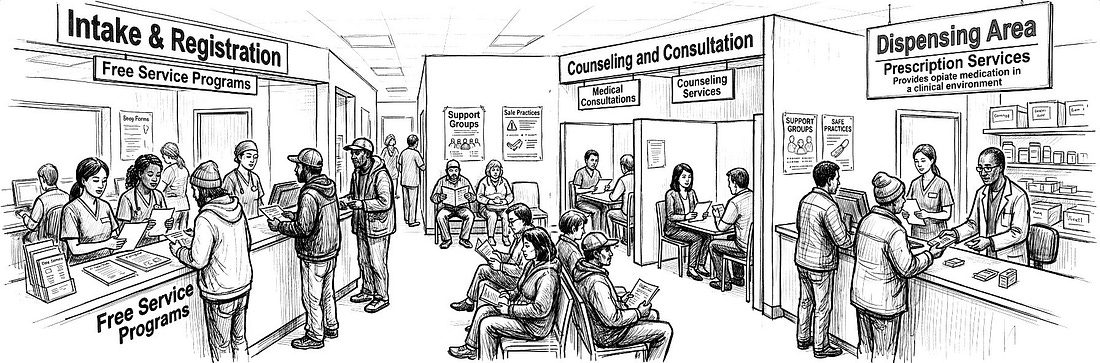
The design questions are real and deserve serious policy attention. Who would be eligible: only existing severe addicts, or anyone? Through what channel: clinics only, or pharmacy distribution? How would pricing be set to undercut the street market without making access trivially easy for new users? How would interaction with criminal law work for violent actors who remain in the trade? One concrete design element worth building in from the start: dispensaries staffed with on-call healthcare providers, present to engage: to consult, to offer pathways toward reduced use or cessation, to connect users with treatment programs when they are ready. The dispensary becomes a point of contact with the healthcare system, something incarceration never managed to be. Switzerland’s heroin-assisted treatment program was compelled to address all of these questions when it launched in the 1990s, and it did so successfully enough that the program is now a permanent feature of Swiss public health. The design is hard. It is not impossible, and the precedent exists.
The moral objection, that the government should not distribute addictive substances, runs into a factual one: it already does. Alcohol and tobacco are regulated and sold under state licensing. Methadone and buprenorphine, both opioids, are prescribed through federally regulated programs to hundreds of thousands of people with opioid use disorder. The government already manages addictive substances; the only live question is whether leaving the opioid supply chain in the hands of cartels is producing acceptable outcomes. The answer is on the death certificate of anyone lost to a fentanyl overdose.
This is not a fringe position. Carl Hart, professor of neuroscience and psychology at Columbia University and author of Drug Use for Grownups: Chasing Liberty in the Land of Fear (2021), argues that most drug use, like alcohol use, is recreational and controlled, and that prohibition does little to prevent the minority of cases that become problematic while destroying the lives of millions who pose no harm to anyone.18 In a Freakonomics interview with economist Steve Levitt, Hart made the economic case with characteristic precision: legal, cheap, pharmaceutical-grade supply would eliminate the violence premium built into illicit prices and redirect enforcement resources toward actual harm.19 Levitt, a skeptic at the outset, concluded the conversation by calling for a state-level pilot of full legalization. That kind of persuasion, from evidence rather than ideology, is the only kind that lasts.
A Roadmap Out The politics of drug reform have been stuck for decades in a binary: total prohibition or imagined chaos. The evidence points toward something more practical. A realistic policy roadmap calls for a sequence of steps, each supported by existing evidence, each building the infrastructure for the next.
Start with what is already politically achievable: repeal federal mandatory minimum sentences for drug possession, a change that commands sixty-four percent public support and bipartisan backing from libertarian conservatives and civil liberties progressives alike. Redirect the sentencing savings into treatment capacity, which remains chronically underfunded relative to enforcement. Fund naloxone distribution at scale. Expand LEAD-style diversion programs nationally. These steps cost less than the enforcement they replace.
From that foundation: pilot federally funded regulated supply programs for opioids, modeled on Switzerland’s heroin-assisted treatment, in a small number of jurisdictions willing to participate. Design them with rigorous evaluation built in. Measure crime rates, overdose rates, treatment entry rates, and public health costs. Publish the results. Run the policy the way you would run a clinical trial: as a question with a measurable answer, evaluated on results. Oregon’s decriminalization experiment is the cautionary tale here, but the lesson is more specific than it appears. Measure 110 decriminalized possession in 2020 before the state had established functional phone lines, triage centers, or funding mechanisms for treatment, in other words, before the infrastructure that makes decriminalization work was in place. The philosophy was not the failure. The sequencing was. Oregon State Senator Michael Dembrow, who supported Measure 110, put it plainly: “The fundamental flaw with Ballot Measure 110 was that it decriminalized first and only slowly funded, designed and implemented the needed treatment programs.”20 Senate Judiciary Chair Floyd Prozanski, who led the implementation effort, told ProPublica that Oregon could have avoided the chaos if lawmakers had acknowledged “we’re not ready for opening up this concept without building the infrastructure that’s needed.”21 Portland’s visible disorder reflected the consequences of skipping the foundation, not the consequences of the reform itself. A federally piloted program that builds treatment capacity first and expands access second would not repeat that error.
In parallel, address the pharmaceutical side of the crisis directly: hold companies that misrepresented the addiction profile of opioids accountable through litigation and regulation, and use settlement revenues to fund treatment programs in the communities most devastated by the prescription opioid wave. The demand that sustains the illicit market was in many cases created by a legal one. Purdue Pharma filed for bankruptcy, the Sackler family paid billions in civil settlements, and litigation continues across the industry, yet not a single pharmaceutical executive served prison time for conduct that addicted millions. The same war on drugs that put nonviolent street-level offenders behind bars for years applied a categorically different standard of accountability to the boardrooms that engineered the crisis.
What Victory Would Actually Look Like The war on drugs will never end the way its architects imagined: with defeat of the enemy, flags lowered, supply chains broken. That victory is not available. It was never available. The adversary, if we must name one, is a persistent feature of human psychology: the impulse toward intoxication and the vulnerability to addiction, documented in every culture and every era of recorded history.
Managing that impulse is the achievable goal: reducing harm, reducing violence, and redirecting the enormous resources currently consumed by enforcement toward treatment, recovery, and community stability.
Other countries have made more progress on that question than we have. Not because they are morally superior, or smarter, or because their populations are somehow less inclined toward substance use. Because they were willing to look at the evidence, accept that the punitive model had failed, and try something different.
That willingness is what has been missing in the United States. For more than fifty years, we have doubled down on a losing hand, persuaded more by the political aesthetics of toughness than by any honest accounting of results. The enforcement bureaucracy has grown too large to advocate for its own contraction. The private prison industry has too much invested in the status quo. And the cultural shorthand of “tough on drugs” still carries electoral weight in enough districts to make meaningful reform politically treacherous for any individual legislator.
But eighty-three percent of American voters already believe the war on drugs has failed.22 Sixty-five percent support ending it. The public is ahead of the politics. The task now is to convert that consensus into a concrete demand: fund treatment, not prisons. Pilot regulated supply, measure the results, and follow the evidence. Repeal mandatory minimums. Stop paying private companies to warehouse people and call it justice.
The trillion dollars is spent. The dead are not coming back. We can spend the next fifty years differently, or we can keep insisting the war is simply unfinished and running up the tab. At some point, the definition of insanity applies.