A Brief History The first social network with recognizable modern features, SixDegrees, launched in 1997. It allowed users to create profiles and connect with friends, mirroring the sociological concept its name invoked. It failed commercially and shut down in 2001. What it left behind was a proof of concept: people would use the internet to maintain relationships, not merely to consume information.
Friendster followed in 2002, MySpace in 2003. Then, in February 2004, a Harvard undergraduate named Mark Zuckerberg launched “thefacebook” from his dormitory. Within a month, half of Harvard’s undergraduates had registered. Within a year, it had expanded to most American universities. By 2008, it had surpassed MySpace as the world’s most visited social network. Twitter launched in 2006. YouTube, acquired by Google that same year, began changing how the world consumed video. LinkedIn had already been quietly building the professional tier of this emerging stack.
What was striking about this first decade, roughly 2004 to 2012, was its genuinely horizontal character. Blogs, early Twitter, and the pre- algorithmic Facebook had a quality of open exchange that was new in human history. A factory worker in Ohio could directly challenge a senator. A student in Tunis could coordinate with an activist in Cairo. The architecture was, briefly, egalitarian in a way that no mass communication medium had ever been.
This was not theoretical optimism. It happened. In late 2010, a street vendor in Tunisia named Mohamed Bouazizi set himself on fire in protest at police harassment. The moment was filmed and shared across Facebook and Twitter. Within weeks, mass protests had toppled Tunisia’s government. The cascade continued: Egypt, Libya, Bahrain, Yemen. An Egyptian activist, speaking to journalists during the January 2011 uprising, captured the infrastructure precisely: “We use Facebook to schedule the protests, Twitter to coordinate, and YouTube to tell the world.”1 The number of Facebook users across the Arab world doubled in the first quarter of 2011 alone.2 Then, around 2012, something shifted. The iPhone had reached critical mass. Facebook acquired Instagram. The mobile internet fused social platforms to human bodies, making them ambient rather than occasional. And the platforms, now carrying Wall Street's expectations, began the transition that would define the following decade: from social graphs to algorithmic feeds, from connecting people to maximizing engagement, from serving users to extracting them.
The Balance Sheet Before examining what went wrong, it is worth being honest about what social media delivered. The ledger is genuinely mixed, and intellectual honesty requires acknowledging both columns.
The gains in the left column are real and historically significant. The costs in the right column did not arise from user failure or cultural weakness. They are the predictable outputs of a specific design choice made at a specific moment by specific people: optimize for engagement above all else.
The Infrastructure We Built and Chose Not to Use Consider what now exists. As of 2025, approximately 5.66 billion people hold social media accounts, representing nearly 69 percent of the global population.3 Collectively, humanity spends over 15 billion hours on social platforms every day, the equivalent of more than 1.75 million years of human existence consumed each week.4 The infrastructure connecting these users is, for most practical purposes, free at the point of use, once an internet connection is paid for. A villager in rural Bangladesh and a pensioner in rural Bavaria can communicate in real time at zero marginal cost.
This is, by any historical measure, an extraordinary fact. The Athenian agora held a few thousand citizens. The printing press reached literate Europeans over the decades. Radio and television were one-to-many, with no mechanism for reply. What social media created, structurally, was the first many-to-many mass communication medium in history, with global reach and near-zero cost.
The question of whether your neighborhood association, your city council, your national parliament, and the international community could theoretically use this infrastructure to deliberate, debate, and decide is not naive. It describes a genuinely available capability. Participatory budgeting experiments in cities like Porto Alegre and Paris have demonstrated that ordinary citizens, given adequate information and structured forums, make sophisticated collective decisions. The technology to scale that model globally exists. We chose not to use it that way.
What the Business Model Destroyed Understanding why requires following the money with precision. Meta alone generated $196 billion in advertising revenue in 2025, with 97 percent of its total income derived from selling attention.5 Social media advertising as a whole is projected to reach $298 billion globally in 2025, expanding its share of all advertising spend to nearly 26 percent.6 Meta is on course to surpass Google as the world’s largest advertising company by 2026.7 These figures are not incidental to how social media behaves. They are its behavioral specification. Advertising revenue is a function of time- on-platform multiplied by engagement intensity. The algorithm’s only task is to maximize both. And the research, including Facebook’s own internal work, has long established what drives engagement most reliably: not satisfaction or enlightenment, but emotional arousal, specifically the negative kind. It is worth being precise here: this is not equally true of every platform. WhatsApp’s closed messaging architecture, LinkedIn’s professional norms, and Wikipedia’s editorial governance each produce different behaviors. The harms described here are most acute in the open, algorithmically ranked feeds of Instagram, TikTok, Facebook, and YouTube, where recommendation engines have the greatest leverage.
Frances Haugen, a former Facebook product manager on its Civic Integrity team, made this explicit when she testified before the United States Senate in October 2021. She told Congress that the company had built “a system that amplifies division, extremism, and polarization” and that executives were aware of the harm but consistently chose profit over correction.8 In her words on CBS’s 60 Minutes: “Facebook has realized that if they change the algorithm to be safer, people will spend less time on the site, they’ll click on fewer ads, they’ll make less money.”9 The internal documents she disclosed confirmed this was a deliberate choice.
The mechanism deserves to be understood clearly. An algorithmic feed does not show you what is true, important, or what your community needs to discuss. It shows you what will make you react. Outrage, fear, and tribal indignation keep users scrolling longer than nuance or agreement ever could. The result, across billions of users over a decade, has been the systematic degradation of the shared factual floor that democratic deliberation requires. When every user inhabits an algorithmically curated reality, civic facts become contested not because the truth is unclear, but because contestation maximizes engagement. The research on political polarization is more contested than the mental health findings, and offline forces, including media economics, geographic sorting, and economic inequality, clearly contribute. But the documented amplification of outrage content is real, and the scale of its reach is unprecedented.
The Human Cost The damage is not only epistemic. Social psychologist Jonathan Haidt has documented what he calls “the great rewiring of childhood,” identifying 2012 as the turning point when the convergence of smartphones and social platforms began producing measurable deterioration in adolescent mental health across the Western world.10 The 2012 inflection is plausible but not inviolable: it coincides with Facebook’s acquisition of Instagram and mass smartphone adoption, and the pattern appears cross-nationally, but other contributing factors, including declining free play and economic stress on families, operate over the same period. The CDC’s Youth Risk Behavior Survey shows that 57 percent of American teenage girls now report persistent sadness or hopelessness, up from 36 percent in 2011. The share who say they have seriously considered suicide has risen from 19 percent to 30 percent over the same period.11 A collaborative review by Haidt, Jean Twenge, and Zachary Rausch, assembling more than 100 correlational, longitudinal, and experimental studies concludes that social media is a major contributing cause of this epidemic, not merely correlated with it, though critics, including Candice Odgers, have argued that the causal evidence remains weaker than the correlational evidence, and that smartphone access may matter more than platform design specifically.12 An internal Meta study, included in the documents Haugen disclosed, found that users who abstained from Facebook for a week reported lower depression and anxiety. The company did not act on this finding.
The harm falls disproportionately on the young, the credulous, and, where platforms have been weaponized by authoritarian states, on entire populations. Facebook’s role in amplifying anti-Rohingya content in Myanmar ahead of the 2017 genocide is one of the most documented cases of platform harm outside Western contexts: a reminder that the harm profile differs sharply between a Norwegian teenager comparing her life to Instagram highlights and a Burmese villager consuming algorithmically amplified incitement.13 The Architecture of the Alternative It is tempting, at this point, to conclude that the technology itself is the problem. That conclusion would be both factually wrong and politically convenient for the platforms, because it diffuses responsibility from specific design decisions onto a neutral abstraction.
The technology is not the problem. Wikipedia, governed by community consensus and editorial norms rather than engagement metrics, remains one of the most remarkable democratic knowledge projects in human history, serving 1.7 billion unique visitors monthly with essentially no advertising. Some municipal community groups function as genuine local deliberative spaces. Certain online forums maintain civil cross- partisan debate. These examples share a common structural characteristic: their design was not optimized for engagement at the expense of everything else.
A social media infrastructure designed to serve democratic deliberation rather than advertising revenue would look substantially different from what we have. It would use chronological or editorially curated feeds rather than engagement-ranked algorithms. It would decouple revenue from time-on-platform, through subscription models, public funding, or hybrid structures, while acknowledging that subscriptions create equity problems of their own: a paywall for civic infrastructure is not a neutral solution. It would build in identity accountability sufficient to impose social norms, without the surveillance architecture that currently monetizes personal data. It would deliberately engineer cross-partisan exposure rather than filter bubbles. None of these things is technically difficult. They are commercially unacceptable under the current model.
The Question Before Us The infrastructure connecting 5.66 billion people exists. The human capacity for reasoned democratic engagement also exists, demonstrated in every functioning jury, every serious town hall, and every deliberative poll ever conducted. Between the two sits a layer of algorithmic incentive structures worth roughly two trillion dollars in market capitalization, and that layer has, so far, won.
The question is whether democratic societies have the political will to regulate that layer, redesign it, or build alternatives before the damage to democratic culture becomes structural. The European Union’s Digital Services Act, enacted in 2022 and now in enforcement, is the most serious attempt to date to impose public-interest obligations on platform design. Beyond regulation, more concrete interventions deserve serious consideration: algorithmic transparency mandates that require platforms to disclose A/B testing results to independent regulators; independent audits of amplification effects; funded pilots of civic deliberation platforms at the municipal level with outcome evaluations; and data portability and interoperability standards that enable genuine competition. The goal is not to make platforms nicer. It is to change the incentive structure so that profit and democratic function are no longer opposed.
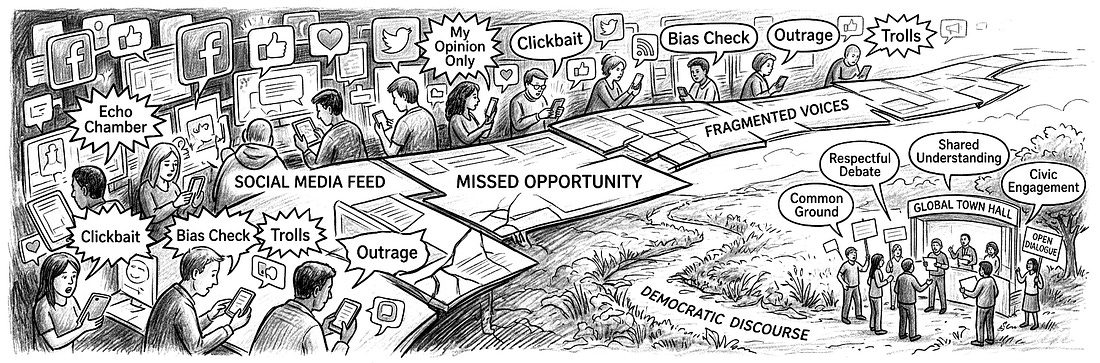
The infrastructure you can see in the image at the top of this page, the divergence between the fragmented feed on the left and the global town hall on the right, is not merely illustrative. It describes a real fork that was taken two decades ago, and one that remains available to take again. The 5.66 billion people are still connected. The choice of what to do with that connection has not yet been permanently foreclosed. But the window is narrowing, market concentration is deepening, lobbying expenditure is rising, and the cultural habituation to algorithmically curated reality becomes more entrenched each year.
The democratic forum has not been built yet. It still could be.