She is thirty-four, holds a graduate degree, earns a salary that would have struck her parents as extraordinary, and lives in an apartment that by any historical measure is comfortable and safe. She is also, by her own account, quietly miserable. Not in crisis. Not in danger. Just carrying a low, persistent sense that she is falling short, that something is wrong with her life, that everyone else seems to be managing better. She scrolls Facebook most mornings before getting out of bed. She knows it makes things worse. She does it anyway.
She stands as a demographic portrait, replicated in the millions across income brackets and geographies. Their distress resists any simple explanation rooted in deteriorating objective conditions. The raw material of their lives remains intact. The measuring stick has changed.
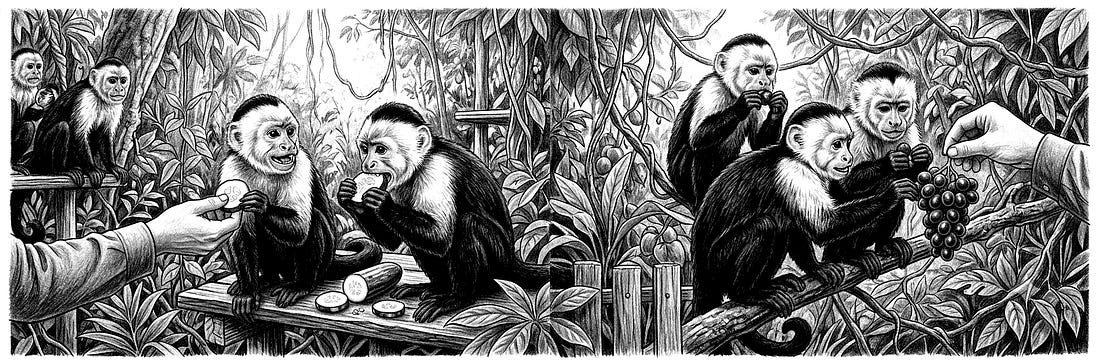
In 2003, primatologists Sarah Brosnan and Frans de Waal published a paper in Nature with an elegantly cruel experimental design.1 Capuchin monkeys were trained to exchange small stones with researchers in return for food. The baseline reward was a slice of cucumber, which the monkeys accepted readily and without complaint. Then the researchers introduced an inequality: one monkey received a grape, a far more desirable food, in exchange for the same. The monkey who still received the cucumber began refusing to participate. Some threw the cucumber slice back at the researcher. Some threw the stone. A few did both.
The monkeys had lost nothing. The cucumber was the same cucumber. The task was the same task. But something had shifted in the perceptual frame, and what had previously been acceptable became, in an instant, intolerable. The researchers called this inequity aversion. What they had actually documented was something older and more universal than economic theory: the animal conviction that fairness is measured not in absolutes, but in comparisons.2 We are, of course, not capuchin monkeys. But we are primates, and we carry the same comparison machinery. For most of human history, that machinery was calibrated against the village, the neighborhood, the immediate social circle. You measured yourself against the people you could actually see, which meant your benchmarks were, on the whole, plausible. Reachable. Real.
Television changed this, and not as gently as we tend to remember. Decades of research in cultivation theory, pioneered by George Gerbner, showed that heavy television viewers systematically overestimated the wealth, professional success, and social ease of people around them, because the screen was their primary source of information about how others live.3 The distortion was real. But television was still a one-way broadcast: passive, scheduled, and populated by characters who were visibly fictional. You could close the comparison at the end of the program.
Social media changed something categorically different. Interactive, peer-to-peer, and hyper-personalized, it replaced the passive broadcast with a mirror pointed directly at your social circle -- and the people you are now comparing yourself to are real. They have names. They went to your school. They used to live in your building. And what they are showing you is not their life but a curated, high-frequency stream of their best moments, posted several times per day, engineered for maximum engagement, and delivered to you before you have fully woken up. The comparison class has not merely expanded. It has been professionalized, optimized, and made inescapable.
The research has followed. A 2023 systematic review of the literature on social comparison, envy, and depressive symptoms found a consistent correlation across every study examined between upward social comparison on social media and depression scores.4 A separate meta-analysis found that each additional hour per day spent on social media was associated with a 13 percent increase in the relative likelihood of depression symptoms among adolescents, a finding worth holding carefully, since it describes a relative risk increase in a specific population, not a universal effect of fixed magnitude.5 Studies testing the reverse, whether reducing social media use improved mood, found that even a one-week abstention from a single platform produced measurable reductions in self-reported depressive symptoms, though the samples were modest and durations short.6 The benchmark does not rise because our lives improve. It rises because someone else’s highlight reel loads every time we unlock our phones.
The effects vary considerably by user and context. Research consistently shows that passive consumption — scrolling without posting — produces worse outcomes than active engagement, such as messaging and creating content. Adolescents and young women are more vulnerable than older adults. People with preexisting anxiety or low self-esteem show stronger negative responses to the same exposure. The platform matters too: image-heavy platforms generate sharper appearance-based comparisons than text-based ones. Social media concentrates its damage on those already carrying the most to lose.
The evidence warrants care about causal claims. The relationship is correlational in most of the literature, and the direction can run both ways: people who are already distressed may seek out more social media, which then amplifies the distress. Longitudinal studies and natural experiments that could more firmly pin down causality remain relatively scarce. What the evidence supports is a consistent, meaningful association running through a mechanism that evolutionary psychology would recognize immediately: we are running ancient comparison software on inputs it was never designed to process.
The formal name for what the capuchins experienced is relative deprivation, a concept first articulated in social psychology by Samuel Stouffer during World War II and later extended by W.G. Runciman in the 1960s.7 The core insight is that people’s sense of well-being tracks the gap between where they are and where they believe they should be, given what they observe around them. You feel poor because the people around you, or the people you are watching, have more.
The hedonic treadmill is the companion concept: as conditions improve, expectations rise to match them, leaving the sense of satisfaction roughly unchanged. Gain a better apartment, and you soon acclimate to it. The new benchmark becomes the larger one you now want. The floor rises; so does the ceiling. Net contentment: flat.
Taken together, these two mechanisms explain something that should be paradoxical but by now feels merely familiar: people in wealthy countries, with access to medicine, safety, food security, and connectivity that would have seemed miraculous to any prior generation, are reporting higher rates of depression and anxiety than at any point in recent recorded history. They have not lost the cucumber. They can see, in very high resolution, that someone else is getting the grape.
Depression rewards more careful framing than gratitude or willpower arguments allow. Depression is a clinical condition with genuine biological components. Genetic predisposition accounts for roughly 35 to 50 percent of the variance in who develops it.8 Adverse childhood experiences, trauma, and economic precarity all leave marks that social media did not cause. Many people who never open Facebook or Instagram still develop major depressive episodes, and many heavy users of every platform do not.
Other structural forces are moving in parallel and cannot be cleanly separated from the comparison dynamic: economic precarity, chronic sleep disruption, driven in part by the same devices, work intensification, and the erosion of community institutions, all independently elevate depression risk. The comparison machine did not invent misery. It runs on top of conditions that were already producing it.
The argument here is narrower. It is that a meaningful and growing subset of what feels, subjectively, like a life gone wrong, persistent low mood, diminished self-worth, a background conviction of inadequacy, is being generated or amplified by comparison dynamics that are historically new in intensity and deliberately engineered for engagement. This subclinical distress may not always meet the threshold for a diagnosis of major depressive disorder, but it is real suffering at real scale, and it shares enough of depression’s architecture to warrant the same seriousness. We are treating an environmental pathogen as though it were an internal character flaw. We are prescribing medication for a sickness that also has an address.
The mechanism runs through envy specifically, and envy is distinct from mere information. Social media delivers knowledge of others’ lives through an emotional channel designed to drive engagement, and envy is one of the most reliable drivers of engagement. Platforms reward content that generates a strong reaction. Content showing aspirational wealth, beauty, travel, and professional success reliably does. The algorithm is a business decision: selecting for the exact inputs most likely to activate relative deprivation, because those inputs keep people on the platform and on the platform’s terms.
The result is an architecture of self-comparison that operates at a scale and frequency no prior society has encountered. The Victorian novelist did not check a curated feed of her social circle’s accomplishments 87 times a day. The medieval peasant did not receive algorithmically optimized updates about the lives of the more fortunate. The capuchin monkey saw one other monkey get a grape and was distressed enough to refuse food. Imagine the capuchin if the grape-receiving monkey were visible, celebrating, every few minutes, all day, on a screen in its hand.
The uncomfortable answer is that the most effective intervention available is also the one people are least willing to make. Reducing social media use is associated with reduced depressive symptoms. The evidence for this is now strong enough that several major health bodies have begun recommending usage limits, particularly for adolescents. The problem is structural: these platforms are designed to resist disengagement, and the social cost of absence is real. Opting out of the comparison machine partially means opting out of the social infrastructure built on top of it.
At the individual level, the research points toward intentionality rather than total abstention: actively monitoring what comparison a given piece of content is producing, distinguishing between passive scrolling and purposeful connection, and building in periods of deliberate separation. At the design level, there are interventions that do not require users to quit: algorithmic de-prioritization of aspirational content, removal of public like counts, friction introduced before passive scrolling begins. Several platforms have experimented with these halfheartedly. None has adopted them at scale, because scale is where the revenue is. School-based digital literacy programs that teach adolescents to recognize comparison dynamics show early promise, though the evidence base remains thin.
At the structural level, the more important question is whether platforms whose business models depend on generating envy should bear any portion of the public health costs of what that model produces. Several European jurisdictions are beginning to require answers through regulatory frameworks. In the United States, federal legislation has stalled, but the pressure is building through other channels: the Surgeon General has called for warning labels on social media platforms, multiple state attorneys general have filed suit against Meta, and California’s Age-Appropriate Design Code has created enforceable design standards for platforms used by minors.9 The argument is no longer fringe. It is becoming a legal question.
The woman scrolling her phone before getting out of bed, a marketing manager in her mid-thirties, say, whose actual life would be unrecognizable as deprivation to almost anyone in human history, is a primate running comparison software in an environment specifically engineered to exploit it. Strong, grateful, and chemically unremarkable, she is nonetheless outmatched by a system designed to make her feel otherwise. The cucumber is fine. The cucumber has always been fine. But every morning, before she has made coffee, she has already seen a hundred grapes.
A design feature. And we have been treating it as a personal one.